Sak Yant FAQ
Welcome to the Sak Yant FAQ. Here you can find answers to the most common questions about Sak Yant tattoos, including their history, meanings, designs, language, spiritual traditions, Monks and Ajarns, and what to expect when receiving a Sak Yant in Thailand. We also cover practical questions about choosing a design, costs, booking, tattooing methods, aftercare, traditional rules, and common misconceptions.
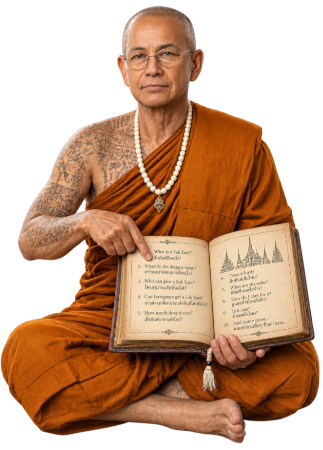
Welcome to Sak Yant FAQ - Questions and Answers about the Sak Yant Tattoo
Understanding the Traditional Thai Tattoo with Sak Yant FAQ – Questions and Answers
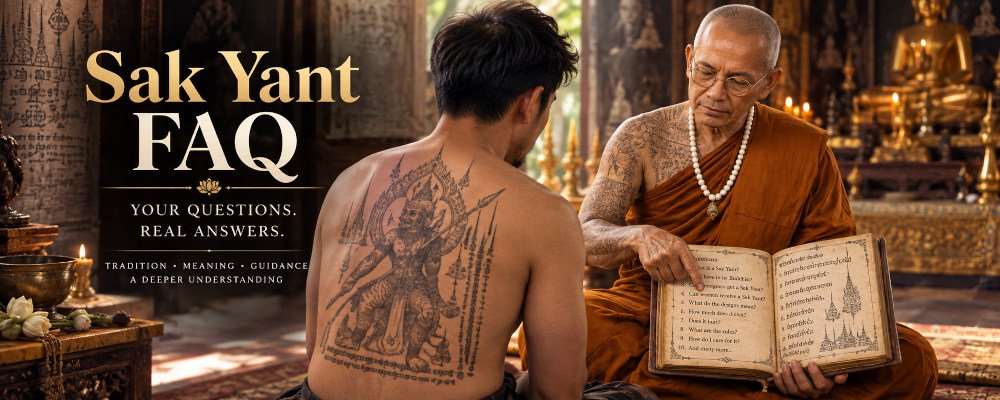
Sak Yant Frequently Asked Questions
Find answers to common questions about Sak Yant tattoos, including their history, designs, meanings, practitioners, rules, spiritual beliefs, safety, aftercare and what to expect when receiving a Sak Yant in Thailand with this Sak Yant FAQ.
1. About Sak Yant
What is a Sak Yant tattoo?
A Sak Yant is a traditional sacred tattoo associated particularly with Thailand and other parts of mainland Southeast Asia. The designs combine sacred geometry, symbolic images and sacred text or mantras, and are traditionally accompanied by rituals and a blessing from a trained practitioner. This is a Monk or Sak Yant Master.
What does the word Sak Yant mean?
"Sak" is a Thai word associated with tattooing or tapping, while "Yant" refers to yantra, a sacred geometric design. Together, Sak Yant refers to the traditional practice of tattooing sacred yantra designs onto the body.
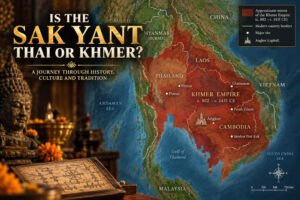
Is Sak Yant Thai or Cambodian?
Sak Yant belongs to an older regional tradition that predates the modern borders between Thailand and Cambodia. Related sacred tattoo traditions have existed across mainland Southeast Asia, including areas that are now Thailand, Cambodia, Laos and Myanmar. Different regions and lineages have developed their own designs, scripts and rituals.
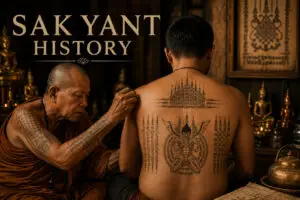
How old is the Sak Yant tradition?
The traditions associated with Sak Yant developed over many centuries and incorporate influences from Buddhism, Brahmanical traditions, local spiritual beliefs and older regional practices. There is therefore no single date that can be identified as the beginning of Sak Yant. It is estimated to be over 1000 years old.
Is Sak Yant a Buddhist tattoo?
Many Sak Yant traditions are closely associated with Theravada Buddhism, Buddhist Monks and Buddhist ritual practices. However, Sak Yant also contains older regional spiritual, Brahmanical and animist influences. Not every design or lineage is exclusively Buddhist.
What makes a Sak Yant different from an ordinary tattoo?
A Sak Yant is traditionally more than the image placed on the skin. Its significance can include the design, sacred text, practitioner, lineage, ritual and blessing. A conventional tattoo artist can reproduce the appearance of a Sak Yant without performing the traditional spiritual practices associated with it. This Makes what the Tattoo Artist makes a 'Bamboo tattoo' not a real Sak Yant.
Why are Sak Yant tattoos considered sacred?
Many Sak Yants contain sacred imagery, prayers, mantras or yantra designs. Traditionally, the tattoo is connected with spiritual beliefs and may be accompanied by chanting, ritual and a blessing. For believers, these elements give the tattoo a significance beyond its physical appearance.
Are Sak Yants only found in Thailand?
No. Related traditions and practitioners can be found in several parts of mainland Southeast Asia and among communities outside the region. Thailand has become particularly associated with Sak Yant because the tradition remains widely practiced there.
2. Designs, Meaning & Language
What do Sak Yant designs mean?
Each Sak Yant traditionally has its own symbolism and purpose. Depending on the design, it may be associated with protection, courage, authority, compassion, prosperity, attraction, success, confidence or other qualities. Meanings can vary between designs and the language used within the design.
What are the most popular Sak Yant designs?
Some of the best-known designs include Gao Yord, Hah Taew, Paed Tidt and Suea Koo, or the Twin Tigers. These have become particularly popular with visitors to Thailand, although popularity does not necessarily determine which Yant is appropriate for an individual.
What is Gao Yord?
Gao Yord, meaning "Nine Peaks," is one of the most widely recognised Sak Yant designs. It consists of nine symbolic peaks and sacred text and is traditionally associated with protection and spiritual significance.
What is Hah Taew?
Hah Taew, meaning "Five Lines," is a Sak Yant consisting of five vertical lines of sacred text. Each line traditionally has its own prayer or purpose, with different lineages sometimes giving the lines different meanings.
What is Paed Tidt?
Paed Tidt is commonly known as the Eight Directions Sak Yant. Its design represents protection in different directions and is traditionally associated with protection and safety while travelling.
What is Suea Koo?
Suea Koo is the Twin Tigers Sak Yant. The tiger imagery is traditionally associated with qualities such as power, authority, courage and strength. Specific interpretations can vary between practitioners.
Can I choose my own Sak Yant design?
Often, yes. Nowdays there is plenty of information available online with the meanings and designs. You can discuss your preferences and intentions with the Monk or Ajarn, who can customize the set designs with unique details and spells. Some traditional designs such as the Master Yants have established forms and sacred texts that should not be altered.
Will the Monk or Ajarn choose my Sak Yant?
Sometimes, usually only when you have not done the research into designs and meanings and chosen yourself and they are forced to choose for you. Practitioners can recommend a Yant based on your intentions, circumstances or traditional methods of selection, while most prefer you to choose. There is no single method used by every practitioner.
Can a Sak Yant be customised?
Yes. Some Yants Master Yants have established traditional forms, while most others can be adapted. Whether changes are appropriate depends on the particular design, sacred text, practitioner and lineage.
What language are Sak Yants written in?
Sak Yant sacred text can use several traditional scripts and languages. Khom script and Pali are particularly common in many Thai traditions, while Lanna, Thai, Khmer and other regional scripts can also occur.
Is all Sak Yant writing in Khmer?
No. Khom script is common in many Thai Sak Yant traditions, but Sak Yant is not restricted to one writing system. The script used depends on the region, practitioner and lineage.
What is Khom script?
Khom is a traditional script used historically in religious and sacred contexts in mainland Southeast Asia. It is commonly encountered in Thai Sak Yant traditions, particularly in sacred inscriptions and yantra designs.
What is Pali and why does it appear in Sak Yants?
Pali is the classical language of Theravada Buddhist scripture and is widely used in Buddhist religious traditions. Pali words, phrases and mantras can therefore appear in Sak Yant sacred text.
What are the three parts of a Sak Yant?
The meaning of a Sak Yant can be understood through three connected elements: the design, the sacred text or prayers, and the ritual blessing. The design provides the visual symbolism, the text provides prayers or mantras, and the blessing forms an important part of the traditional spiritual practice.
3. Monks, Ajarns & Authenticity
Who can give a Sak Yant?
Traditionally, Sak Yant is given by a trained spiritual practitioner, most commonly a Buddhist Monk or an Ajarn. An Ajarn is generally a lay practitioner who has received training and knowledge through a lineage.
What is an Ajarn?
Ajarn is a Thai term meaning teacher or master and can be used in several contexts. In Sak Yant traditions, it commonly refers to a lay practitioner who has received training in the tattooing, sacred texts, rituals and traditions associated with a lineage. Almost all Ajarns are ex-Monks.
What is the difference between a Monk and an Ajarn?
A Monk remains part of the Buddhist monastic community and may perform Sak Yant as part of his religious practice. An Ajarn is generally a lay practitioner who works outside the monastery and may previously have been a Monk. Their practices and ceremonies can differ between lineages.
Can any Monk perform a Sak Yant?
No. Buddhist Monks are traditionally among the practitioners associated with Sak Yant. However, not every Monk performs Sak Yant, and individual Monks and temples have their own practices. Sak Yant rituals and magical blessings are an advanced form of practise. So the Monk needs to be a trained Sak Yant practitioner.
Is an Ajarn a former Monk?
Yes. Some Ajarns previously trained or lived as Buddhist Monks before becoming lay practitioners. This is one way knowledge and traditions can pass between monastic and lay Sak Yant practitioners.
Can any tattoo artist create Sak yant like an Ajarn?
No. Simply knowing how to reproduce a Sak Yant design does not necessarily make someone an Ajarn. Traditionally, the term relates to teaching, training, knowledge and lineage rather than simply tattooing ability.
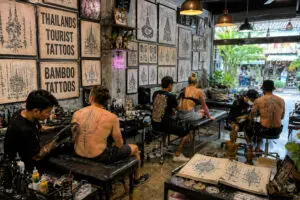
Can I get a Sak Yant from a normal tattoo shop?
No. A tattoo shop can reproduce the appearance of a Sak Yant referred to as a Bamboo Tattoo based on the handpoke method of applying it. But this is different from receiving a traditional Sak Yant from a trained Monk or Ajarn. A conventional tattoo artist may reproduce the artwork without having the traditional knowledge, lineage, rituals or blessing, almost always with gibberish text in the design.
What makes a Sak Yant authentic?
There is no single international certification that determines whether a Sak Yant is authentic. Traditionally, authenticity is connected with the practitioner's training, lineage, knowledge of sacred texts, ritual practice and blessing. Sak Yant Masters will call their magical tattoos a Sak Yant, whereas copies and replica by tattoo shops are referred to as Bamboo Tattoo.
Does a Sak Yant have to be performed at a temple?
No. Sak Yants can be performed at temples, monasteries, Samnaks and other locations associated with individual Ajarns. The location alone does not determine whether a Sak Yant is traditional.
How can I choose a reputable Sak Yant practitioner?
Look for information about the practitioner's training, lineage, experience, location, practices and reputation. It is also important to understand exactly what is included in the experience rather than choosing solely on the appearance of the tattoo or the price. Real Masters will not make the rituals and blessing an option - they are part of the process. When looking at social media photos, generally real and authentic Sak yant places will have photos of the rituals and Blessing.
4. Foreigners, Women & Religion
Do I have to be Buddhist to receive a Sak Yant?
No. Sak Yant is received by people from many different religious and cultural backgrounds. However, receiving one traditionally involves showing respect for the Buddhist and cultural traditions associated with the practice.
Can foreigners get a Sak Yant?
Yes. Foreign visitors can receive Sak Yant in Thailand. Many Monks and Ajarns regularly work with international visitors.
Can non-religious people receive a Sak Yant?
There is no universal requirement that the person receiving a Sak Yant must identify with a particular religion. However, someone receiving a sacred tattoo should understand and respect the religious and cultural traditions associated with it.
Can women get a Sak Yant?
Yes. Women can receive Sak Yant, although practices vary between Monks, Ajarns, temples and lineages.
Can a woman get a Sak Yant from a Monk?
This depends on the Monk and circumstances. Some Monks do not tattoo women in a Temple because of monastic practices concerning physical contact, while many Ajarns tattoo women. In some situations an Ajarn may perform the tattoo while a Monk performs the blessing. Monks are free to preform Sak Yants on Women outside of the Temple in Samnaks.
Why do some Monks not tattoo women?
This is generally connected with monastic rules and traditional practices concerning physical contact (which might arise to sexual thoughts) between Monks and women. Practices differ between individuals and locations. Some Monks are old, some are gay and these thoughts are not an issue. The Monks have generally decided it is not worth the gossip among villagers who project their own standards into Monk behaviour.
Can a foreign woman get a Sak Yant from an Ajarn?
Yes. Many Ajarns perform Sak Yants for women and international visitors. However, each practitioner has their own practices, so this should be confirmed before booking.
Is it disrespectful for a foreigner to get a Sak Yant?
Receiving a Sak Yant as a foreigner is not automatically disrespectful. Respect involves understanding the tradition, behaving appropriately, choosing a genuine practitioner and treating the tattoo as something more meaningful than a souvenir. Getting a Bamboo Tattoo from a tattoo artist that attempts to recreate the look without the Spiritual components is considered disrespectful.
Is getting a Sak Yant cultural appropriation?
Views on cultural appropriation depend on how a sacred tradition is approached and represented. Sak Yant is a living tradition received by people from different backgrounds, including foreigners. Treating sacred designs purely as decoration without understanding their meaning can raise different cultural concerns. This is usually the case with Tattoo Artistic replicas, not so much with the real and authentic Sak Yant.
Can someone from any religion receive a Sak Yant?
There is no single universal religious requirement. People from different backgrounds receive Sak Yants. However, the beliefs and requirements of the individual practitioner should always be respected.
5. Getting a Sak Yant
How do I get a Sak Yant in Thailand?
The process depends on the practitioner or temple. Generally, you choose a suitable Monk or Ajarn, arrange an appointment if necessary, discuss the design and meaning, make the appropriate offering or payment, receive the tattoo and participate in the blessing or ceremony. There are many Sak Yant providers with websites and google listings that arrange translations and various services.
What happens when I arrive for my Sak Yant?
The process varies. You may first discuss the design, purpose and placement with the practitioner. Then there are an offering, preparation, tattooing, chanting and a final blessing.
Can I choose the design before I arrive?
Usually, you can research designs and discuss your preferences beforehand. Many more modern Masters and Sak yant providers are busy and provide booking of times. In this case it is important to have your design in mind so you can book the appropriate amount of time. However, some practitioners prefer to recommend or confirm the design during the consultation.
Should I show the Monk or Ajarn a picture of the design?
You can show a practitioner a design that interests you. This can be particularly useful when discussing placement and the style you are looking for. The practitioner can then determine whether the design is appropriate for their tradition. It is however important to have obtained the design from authentic sources and not used AI or image galleries where people have submitted art as well as traditional designs.
Can I bring my own Sak Yant design?
Yes, you can show a practitioner your preferred design. However, sacred text found online may be inaccurate or incomplete, so it is important to have the design checked by someone knowledgeable in the tradition. You can not make up your own design or use AI, and you should check that the design you have in mind is a real Sak Yant first.
Can I choose where my Sak Yant is placed?
Placement depends on the design, practitioner and tradition. The upper back, shoulders and arms are common locations, while some sacred imagery has traditional placement restrictions. Generally only animal images can go below the waist.
Can I get a Sak Yant below the waist?
Some Animal designs may be permitted below the waist, while others have traditional restrictions. Sacred Buddhist imagery generally has stricter expectations regarding placement, particularly around the feet.
Can I get a Sak Yant on my leg?
This depends on the design and practitioner. Some Sak Yant traditions permit certain Animal designs on the legs, while others may have restrictions concerning particular sacred images.
Can I get a Sak Yant on my foot?
No. Sacred imagery placed near or on the feet can be considered inappropriate in some Buddhist and Thai cultural contexts. The practitioner should always be consulted before choosing this placement.
How long does a Sak Yant take?
A small design can take a relatively short time, while a large or complex Yant can take several hours. The total experience can take longer because consultation, offerings, preparation, chanting and blessing may also be involved.
What happens during a Sak Yant ceremony?
The exact ceremony depends on the practitioner and lineage. A traditional experience may include an offering, consultation, preparation, tattooing, sacred chanting and a final blessing.
What should I wear when getting a Sak Yant?
If you are visiting a temple or religious setting, modest clothing is appropriate. Your clothing should also allow easy access to the part of your body being tattooed.
What should I do before getting a Sak Yant?
Get enough sleep, eat normally, stay hydrated and avoid arriving intoxicated. Avoid alcohol before the session and tell the practitioner about relevant medical or skin concerns.
Should I eat before getting a Sak Yant?
It is generally sensible to eat normally before a tattoo session rather than arriving hungry. Staying hydrated is also useful, particularly in Thailand's hot climate.
6. Cost, Booking & Practical Questions
How much does a Sak Yant cost?
There is no single price. Cost varies according to the practitioner, location, design, size, complexity and whether the tattoo is performed at a temple or by an independent Ajarn. Smaller rural locations, less famous Masters will generally be cheaper than city based and well promoted Masters. The good news is however that a Real Sak Yant usually costs 50-70% less than a copy from a commercial Tattoo Artists.
Is a Sak Yant free?
No. Temples and Monks traditionally receive offerings or donations to exist, often requesting a Sak Yant Monk when the Temple requires more funds. Thai people know to ask what donation is required, but tourists often assume because the Monk can not directly say a price it is free. It is important to note that many Monks and Temples no longer provide Sak Yants for non Thais any longer due to this lack of knowledge or intentional abuse by bloggers and tourists. Ajarns charge established prices for their time and work.
Is a Sak Yant really only a donation?
No. Most practitioners operate with clearly stated prices, however Monks are not able to request fees for their services. The term donation is used by Thai people as a polite way of asking "How Much". In the case where a local person has spent years making donations to a Temple, they might get a Sak Yant for free or a smaller price. For visitors both Thai or Westerner it is expected that you ask how much 'donation' should you provide for this or that design as well as services such as house blessings and funerals.
Do I need to book a Sak Yant in advance?
It depends on where you are going. Some temples accept visitors without appointments, while many Ajarns and private Samnaks operate by appointment. If you are going to places you have found online or heard of via reputation it is probably best to book if you wish to ensure actually getting a Sak Yant tattoo.
How far in advance should I book?
There is no universal booking period. Popular practitioners may have limited availability, particularly during busy travel periods, so advance booking is advisable if your travel dates are fixed. Sak Yant Chiang Mai for example is usually booked 2-3 weeks in advance during high tourist season.
Can I get a Sak Yant without an appointment?
Some locations accept walk-in visitors, while others require appointments. Never assume that a Monk or Ajarn will be available simply because you have arrived at their location.
How do I pay for a Sak Yant?
Payment practices vary. Some practitioners accept cash only, while a few others may offer additional payment methods. Confirm the current payment arrangements before your appointment. Generally a booking deposit can be made via a credit card, but the donation for the rest of the spiritual service is done in cash.
Do I have to pay extra for the blessing?
No. A Real Sak Yant includes all the rituals and Blessings. If a Sak Yant provider offers Blessings at additional service and cost - they are probably a tattoo artist and not a legitimate Sak Yant Master
Can I take photographs during the Sak Yant ceremony?
Photography rules vary between temples and practitioners. Always ask permission before photographing Monks, ceremonies, sacred objects or other people.
Can I bring someone with me?
This depends on the location and practitioner. Some places may allow a companion, while others may prefer to keep the tattooing and ceremony private.
Can I get more than one Sak Yant in one visit?
This depends on the practitioner, designs and amount of time available. Some people receive multiple Yants during a single session, while others receive them separately.
Can I get another Sak Yant later?
Yes. Many people receive additional Sak Yants over time. The appropriate combination, order and placement can depend on the practitioner and lineage.
7. Rules & Spiritual Beliefs
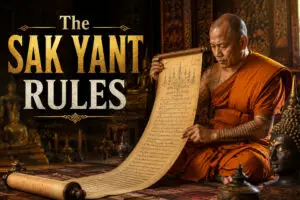
What are the Sak Yant rules?
Sak Yant rules, sometimes called Khor Ham, are behavioural guidelines associated with the tradition. Common principles can include avoiding harm to others, avoiding theft and dishonesty, respecting parents and elders and avoiding certain behaviours considered inappropriate by a particular lineage.
Are the Sak Yant rules the same for everyone?
No. There is no single universal list followed by every practitioner. Different Monks, Ajarns and lineages may teach different rules.
Does every Sak Yant have rules?
Rules and restrictions vary between practitioners and traditions. Some practitioners provide specific behavioural guidelines, while others place greater emphasis on general ethical conduct.
What happens if I break a Sak Yant rule?
Different traditions explain this differently. Some practitioners teach that breaking the rules can weaken the spiritual relationship with the Yant, while others emphasise the ethical purpose of the rules themselves.
Will something bad happen if I break a Sak Yant rule?
There is no universal punishment associated with breaking a Sak Yant rule. Beliefs about consequences differ between practitioners and lineages.
Does a Sak Yant lose its power if I break a rule?
Some practitioners believe that failing to follow the rules can weaken the spiritual effectiveness of a Yant. Others place greater emphasis on the ethical meaning of the rules. These are traditional beliefs rather than scientifically established effects.
What is the blessing at the end of a Sak Yant?
The blessing is an important part of the traditional ritual. The practitioner may use chanting, prayer and ritual actions according to their lineage and practice. For believers, this is the part of the ceremony through which the Yant is spiritually empowered or activated.
Can a Tattoo Artist Sak Yant Replica get a Blessing?
No. Tattoo Artists do not understand the ancient language, rituals and most importantly live a lifestyle where they do not qualify as being able to Bless a Sak Yant. Many will tell customers they can have their Sak Yant blessed later by a Monk. This is not possible, as a Sak Yant Monk can not blessed fake text where sacred text is supposed to be
What is a Wai Kru?
Wai Kru means "paying respect to the teacher." In Sak Yant traditions, Wai Kru ceremonies can involve showing respect to one's teacher, lineage and spiritual tradition.
Is Wai Kru required for every Sak Yant?
No. Large Wai Kru ceremonies are associated with particular temples and traditions, but not every Sak Yant session includes a large public Wai Kru ceremony.
Does the power of a Sak Yant come from the ink?
No. Traditional belief does not generally describe the ink alone as the source of a Sak Yant's power. Its spiritual significance is associated with the design, sacred text, practitioner, ritual, blessing and conduct of the person wearing it. The power to activate the Sak Yants magical benefit comes from the purity of the Masters; which comes from the way they life their life.
Can a Sak Yant protect you from physical harm?
Protection is an important traditional belief associated with some Sak Yant designs. However, spiritual protection should not be understood as a substitute for ordinary safety precautions or medical care.
Can a Sak Yant bring good luck?
Some Sak Yant designs are traditionally associated with luck, prosperity, success or attraction. These are spiritual and cultural beliefs rather than scientifically established effects.
Does a Sak Yant have supernatural powers?
Different practitioners and devotees hold different beliefs about the spiritual power of Sak Yants. These beliefs are part of the religious and cultural tradition and cannot be presented as scientifically proven effects. .
8. Safety, Healing & Aftercare
Does a Sak Yant hurt?
Yes. A Sak Yant is still a tattoo, so some discomfort should be expected. Pain varies according to the individual, design, location and technique.
Is a Sak Yant more painful than a machine tattoo?
There is no universal answer. Some people find hand-poking easier to tolerate, while others find it more uncomfortable. The sensation is different from a machine tattoo because the instrument is repeatedly tapped into the skin.
What is a Khem?
A Khem is the traditional metal rod used for hand-poking a Sak Yant. The practitioner repeatedly taps the pointed metal instrument into the skin to create the tattoo.
Is a Khem the same as a bamboo needle?
No. Traditional Sak Yant practitioners commonly use a metal Khem. The term "Bamboo Tattoo" is widely used in English to describe hand-poked tattooing, but the traditional Sak Yant instrument is generally a metal rod.
Is it safe to get a Sak Yant?
Yes. A Sak Yant should be treated with the same health and hygiene considerations as any other tattoo. There are almost no Sak Yant practitioners who don't use appropriate sterile or single-use equipment, fresh ink and clean working practices. Tattoo Shops will often suggest getting an Authentic Sak Yant from a Master has hygiene risks, but this is not the case.
Are Sak Yant needles reused?
No. Modern professional practitioners use sterile, single-use or appropriately sterilised equipment.
How can I check whether the equipment is hygienic?
You can ask how the equipment is sterilised, whether needles or components are single-use, how surfaces are cleaned and how ink is handled. A reputable practitioner should be comfortable explaining their hygiene procedures. However this usually just shows that you have relied on tourist blogger posts and not common sense. There is only a single Blogger who did not offer any 'donation' for their Sak Yant at Wat bang Phra - and since he did not pay for new ink and needles he did not get them. .
Can I get a Sak Yant if I have a skin condition?
This depends on the condition and its location. Anyone with an active skin problem, infection or other relevant medical concern should discuss it with an appropriate healthcare professional and the practitioner before tattooing.
What should I do after getting a Sak Yant?
Follow the specific aftercare instructions provided by your practitioner. Generally, keep the tattoo clean, avoid unnecessary friction and do not pick or scratch healing skin.
How long does a Sak Yant take to heal?
Healing varies according to the size and location of the tattoo, your skin and your aftercare. Generally, around 3 days.
Can I swim after getting a Sak Yant?
A fresh tattoo should generally be protected from prolonged soaking and exposure to potentially contaminated water during the initial healing period. No swimming or bathing for 3 days after the Sak Yant.
Can I go in the sea after getting a Sak Yant?
It is generally advisable to wait until the tattoo has sufficiently healed (3 days) before exposing it to seawater. Your practitioner should provide specific guidance based on the tattoo and healing process.
Can I exercise after getting a Sak Yant?
Exercise can create friction, sweating and stretching around a fresh tattoo. Follow your practitioner's aftercare instructions and avoid activities that could irritate the tattoo while it is healing. Generally, around 3 days no physical activity that causes stretching.
Is a Sak Yant permanent?
Yes. A Sak Yant is a real tattoo and is intended to be permanent. Like other tattoos, it can gradually change in appearance as the skin ages.
Can a Sak Yant be removed?
Tattoo-removal methods such as laser treatment can remove or lighten a Sak Yant. However, some practitioners and devotees regard removing a sacred tattoo as disrespectful to the tradition.
9. Common Myths & Misconceptions
Are all Sak Yants Buddhist?
No. Many Sak Yant traditions have strong Buddhist connections, but they also incorporate older regional spiritual traditions, Brahmanical influences, sacred geometry and local beliefs.
Are all Sak Yants made by Buddhist Monks?
No. Sak Yants can be performed by both Buddhist Monks and Ajarns. Ajarns are lay practitioners who may have trained within a particular lineage and may previously have been Monks.
Can only Thai people receive a Sak Yant?
No. Sak Yants are received by people from many countries and backgrounds. Foreigners have been receiving Sak Yants from Thai practitioners for many years.
Does a Sak Yant have to be written in Khmer?
No. Different Sak Yant traditions use different scripts and languages. Khom and Pali are common in many Thai traditions, but Lanna, Thai, Khmer and other regional writing systems can also appear.
Is every Bamboo Tattoo a Sak Yant?
No. Bamboo Tattoo is commonly used as a broad term for a hand-poked tattoo technique usually done by Tattoo Artists. A tattoo can be hand-poked without being a traditional Sak Yant.
Is every hand-poked tattoo a Sak Yant?
No. Hand-poking describes a tattooing technique. A Sak Yant is associated with particular designs, sacred texts, traditions, practitioners and rituals.
Does a Monk have to read my aura to choose my Sak Yant?
No Reading auras is not part of Buddhist practise. Some practitioners may use spiritual practices or traditional methods when recommending a Yant, while others simply discuss the person's intentions.
Does the Monk know which Sak Yant I need automatically?
Not necessarily. Different practitioners have different methods. Some recommend designs, while others allow the person receiving the tattoo to choose. It is you who live with yourself and know what you need. A Sak Yant Master who has met you for 10-15 minutes has very little idea and prefers you bring your own knowledge to the table.
Is the meaning of every Sak Yant exactly the same?
No. Meanings can vary between practitioners, regions and lineages. A design may have a generally recognised meaning while also having additional interpretations within a particular tradition.
Are the five rules the same for every Sak Yant?
No. There is no single universal list of rules that applies to every Yant and every practitioner. Different lineages may teach different rules.
Is a Sak Yant just a tourist tattoo?
No. Sak Yant is a living religious and cultural tradition that is practiced by Thai people as well as international visitors. However, the modern tourist industry has also created commercial versions of Sak Yant imagery, which are not necessarily equivalent to receiving a traditional Sak Yant. A Bamboo tattoo from a tattoo shop is a replica and considered a tourist tattoo.
Is a Sak Yant just a normal tattoo with magical writing?
No. Traditionally, its significance comes from several connected elements, including the design, sacred text, practitioner, ritual, blessing and associated beliefs. The physical tattoo is only one part of the tradition.
Does the ink contain special magical ingredients?
No. Long are the days when Masters had to make their own ink - nowdays they buy it from the same places as tattoo shops. The spiritual significance of a Sak Yant is not simply determined by the physical ingredients in the ink. Traditional beliefs focus on the design, sacred text, practitioner, ritual and blessing.
Does a Sak Yant guarantee protection?
No tattoo can scientifically guarantee protection from injury, illness or other dangers. Protection is a traditional spiritual belief associated with particular Sak Yants.
Do I lose the power of my Sak Yant if I stop believing in it?
There is no universal answer. Different practitioners and traditions have different explanations of the relationship between belief, conduct and the spiritual effectiveness of a Yant.
Is it disrespectful to get a Sak Yant if I do not understand it?
Understanding the meaning and cultural context is an important part of approaching a sacred tradition respectfully. Visitors should make a reasonable effort to understand what they are receiving rather than treating the design purely as decoration.
Can I copy a Sak Yant design and have a normal tattoo artist reproduce it?
No, a tattoo artist can reproduce the artwork, but that is different from receiving a traditional Sak Yant. The traditional practice includes elements beyond the visual design, including sacred text, lineage, ritual and blessing.
Best Place to Get a Sak Yant Tattoo in Thailand
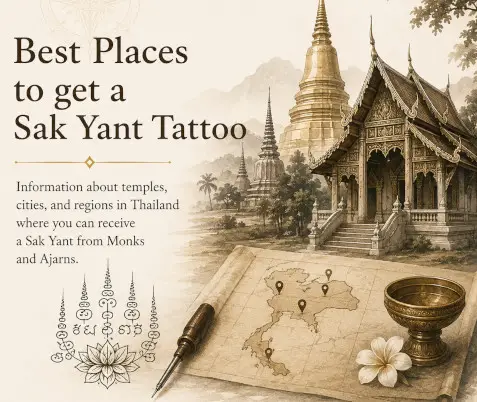
For someone looking to receive an authentic Sak Yant in Thailand, Chiang Mai and Bangkok are two of the most established destinations to consider. Chiang Mai is particularly known for its long-standing Northern Thai Sak Yant lineages and the variety of experienced Monks and Ajarns working in the area, while Bangkok offers access to numerous established Masters, temples and Ajarns from different traditions.
Both cities also make it easier for international visitors to arrange a Sak Yant, understand the ritual and choose between temple and private Samnak settings. The most important consideration, however, is not simply the city but the individual Master, their lineage, experience and the authenticity of the ritual and blessing they provide