Why You don’t get a Tattoo Shop Sak Yant
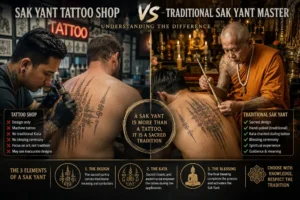
Tattoo Shop Sak Yant vs Traditional Sak Yant Masters

Understanding the Difference between authentic culture and the tourist bamboo tattoo

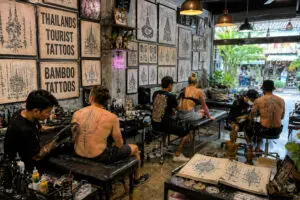
Thailand is famous for affordable tattoos, and it is almost impossible to walk through Bangkok, Chiang Mai, Phuket, Pattaya, or Pai without seeing numerous tattoo studios. Alongside convenience stores, massage businesses, and tailor shops, tattoo studios have become a familiar part of the tourist landscape. Many of these studios display traditional Thai designs, including Sak Yant tattoos. Some advertise “Bamboo Tattoos,” while others offer machine tattoos inspired by traditional Sak Yant artwork. For visitors who are unfamiliar with Thai culture, it can be difficult to understand the difference between receiving a Sak Yant inspired artistic replica tattoo in a commercial studio and receiving a traditional Sak Yant from a practicing Monk or Ajarn.

Although both experiences may produce visually similar artwork, they are based on very different traditions and purposes.

What Is a Traditional Sak Yant?

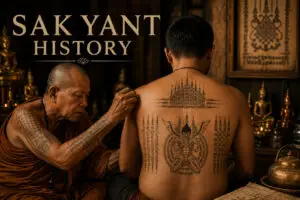
Traditionally, a Sak Yant is performed by a Monk or Ajarn who has spent years studying both the artistic and spiritual aspects of the practice. The tattoo itself forms only one part of the overall experience.

The traditional Sak Yant rituals that make it a spiritual and cultural aspect of Thai Culture includes:

  1.  Selection of an appropriate design that represents the meaning or intention a person desires the tattoo for.
  2. Traditional hand-poked application using a steel khem Chanting of Kata during the tattooing process
  3. A final blessing intended to activate the Yant’s spiritual significance

For many people, this ceremonial process is just as meaningful as the finished tattoo itself.

What Is a Sak Yant Tattoo Shop?

Today, many professional tattoo studios offer Sak Yant inspired replica artwork. Some use traditional bamboo-style hand techniques, while many use modern tattoo machines.

These studios often produce beautiful tattoos and employ highly skilled artists. Their focus is generally on producing quality body art rather than providing a traditional religious or ceremonial experience.

For visitors who simply appreciate the artistic style of Sak Yant, a tattoo studio may be a perfectly suitable option. For those seeking the traditional practice, however, there are important differences to understand before making a decision.

Bamboo Tattoo vs Sak Yant: Key Differences

CategoryBamboo Tattoo (Tourist Tattoo Shops)Traditional Sak Yant
Who Performs ItCommercial tattoo artistsMonks or trained Ajarns
PurposeDecorative / aestheticSpiritual, protective, symbolic
TrainingModern tattoo training – No knowledge of reading the ancient scriptsSpiritual lineage and ritual training in Magical Languages
TechniqueHand-poked with Incorrect designsTraditional hand-poking methods
Rituals / BlessingsNoneChanting, blessings, sacred rites
Cultural SignificanceTourist-oriented interpretationDeeply rooted in Thai spiritual tradition
Terminology“Bamboo tattoo” (modern term)Sak Yant (traditional term)
ExperienceCommercial transactionRitual experience

Many tattoo shop websites and even Google ads for their business promote Sak Yant Bamboo Tattoo designs, catering to tourists. This is done despite the practice of representing replica and essentially fake designs as ‘Sak Yant’ being frowned upon by Thai society. Genuine Sak Yant Masters and academics who do not support this tattoo parlor commercialization of their cultural heritage. These objections are rarely heard as

1) Sak Yant Masters prioritize spiritual practice over controversy, and remain silent
2) Scholars publish primarily in Thai language and in academic journals that do not get great results in Google.

Outside of tattoo shop promotions and travel bloggers that incorrectly link bamboo tattooing to Sak Yant traditions, the experts agree that such misrepresentations are highly disrespectful. Promvek and Chumnaseaw’s 2024 study highlights tattooing as a significant part of Thai heritage but notes that foreign tourists often lack cultural awareness.   “One thing that is of interest to foreign tourists is tattooing. Tattooing is an important cultural heritage that has been a part of Thai society for a long time and reflects one of the contexts of beliefs“.

The paper mentions international artists, such as Angelina Jolie, Brad Pitt, Anthony Bourdain and Ed Sheeran, receiving Thai tattoos, further fueling interest. “Thai tattooing has rapidly spread to foreigners. Famous foreign artists have continuously traveled to get Thai tattoos” The latest being  11 February 2024 Mr. Ed Sheeran, a  British artist who loves tattoos gets a tattoo from Master Neng Kummantrarak“.

This article will explore why historians, scholars, and Sak Yant experts urge tourists to seek authentic Masters rather than commercial tattoo shops that mimic the design without any relevance to the Culture and traditions behind it.

Why Do Many Visitors Choose a Traditional Sak Yant Master and not a Tattoo Artist?

Understanding the Difference between authentic culture and the tourist bamboo tattoo

1) The Importance of Sak Yant Tattoo in Thai Culture

Respect for Thai CultureSak Yant tattoos, also known as “Yantra tattoos,” are closely associated with Thai and broader Southeast Asian spiritual traditions. (1)(3)(4). Traditionally, they are administered by Buddhist Monks or trained spiritual practitioners, known as Ajarns, using a hand-poked method with metal needles.

The importance of qualified practitioners is highlighted by National Geographic (1), which notes that historically, many respected tattoo masters were Monks skilled in Pali, yantra, and related spiritual practices.

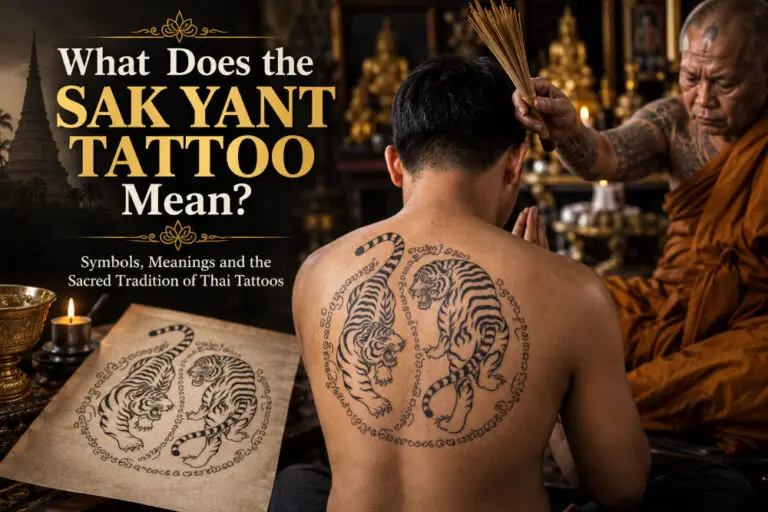
Each Sak Yant design has traditional meanings and is associated with qualities such as protection, strength, good fortune, and other blessings. The process may also include offerings, chants, rituals, and a sacred blessing connected to the spiritual significance of the tattoo (3).

Nantchaya Mahakhan explains that traditional Thai tattooing is connected to beliefs in magical and spiritual powers, including good fortune, protection, longevity, charm, and escaping danger. The designs themselves can represent yantra or other sacred images associated with these beliefs.

Tattooing has long formed part of Thai cultural heritage and reflects traditional beliefs within Thai society (10). For this reason, Sak Yant involves more than simply reproducing a visual design. The practitioner, method, traditions, meanings, and beliefs surrounding the tattoo all form part of its cultural context.

As Sak Yant has become increasingly popular internationally, traditional designs are sometimes reproduced as purely decorative tattoos. While modern tattooing has its own place, presenting a decorative reproduction as an authentic traditional Sak Yant may overlook the cultural and spiritual context from which these designs originated.

A respectful approach recognises Sak Yant as a living cultural tradition and considers its history, meanings, traditional methods, and the role of the practitioner.
2) The Components that make a real Sak Yant Tattoo

One of the best resources for Sak Yant Information in English is the Sak Yant Chiang Mai’s website.  With the advantage of consulting many different Sak Yant Masters around the country it consolidates accurate knowledge in English. Sak Yant Chiang Mai report (9) there are 3 aspects that make a Sak Yant authentic, the 2 most important of the factors are missing in the fake Sak Yant designs made by tattoo shops.

The 3 aspects include
1) The Design (Picture)
2) The Khata (Text around the picture)
3) The Rituals and Blessing

Issue arise for the Tourist getting a Bamboo Tattoo, as almost every design a tattoo artists uses they download from online.  Sak Yant Masters will not release true designs with correct magical spells because of the danger of attempting magic by the untrained which can cause bad luck and misfortune.  The magical Khata is created freehand by Sak Yant Masters along with chanting of magical mantras as the design is created.  “It is then pierced into the skin to create characters. pattern With the word “talisman” Which means character shape Khmer script is written according to the principles of Buddhism and in patterns based on beliefs”. (Liu, Q., 2565, p.8)

Tattoo Artists without any training in the ancient magical languages used in Sak Yant Tattoos will just copy the incorrect magical text used in their catalogs; or worse replica what the customer decides is the ‘cool looking tattoo they want’

The most widely emphasized aspect of the true Sak Yant is the importance of the Rituals and blessings. The key aspect of what makes a Sak Yant a Magical and authentic Traditional Thai Tattoo.

3) The Rituals and Magical Blessing - Devoid in Tourist Bamboo Tattoo Shops

An important aspect of traditional Sak Yant is the role of rituals and blessings, which form part of the cultural and spiritual context surrounding the tattoo. These practices can include making an offering to the Sak Yant Master before the tattoo and receiving a blessing afterwards. Historical and academic commentary on Sak Yant describes these practices as an important part of the traditional process.

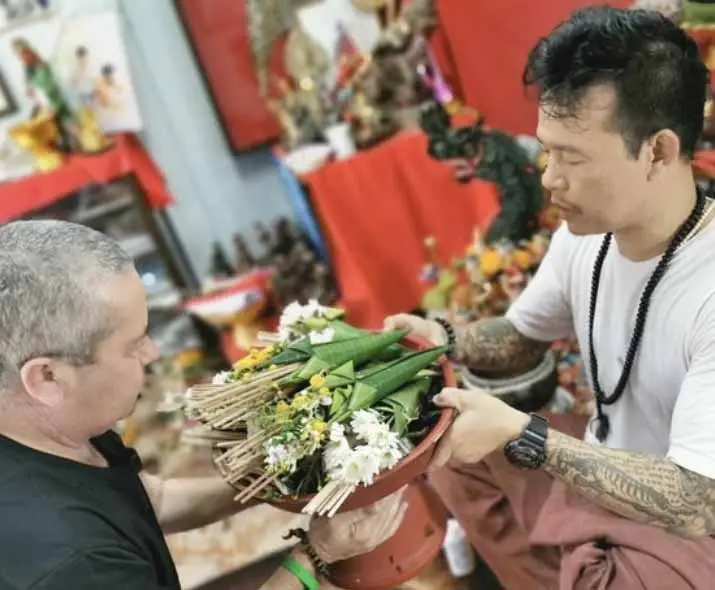
Sak Yant Tattoo Offering
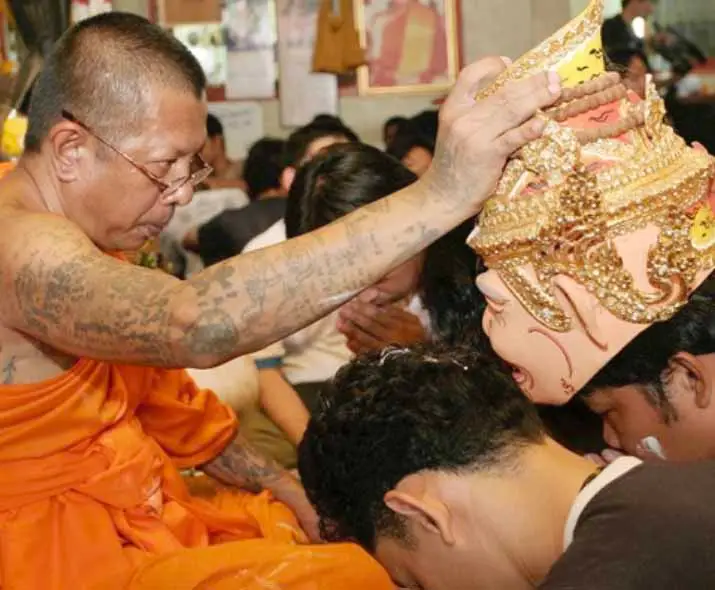
Sak Yant Tattoo Monk Blessing

1. The Offering: Showing respect for the Sak Yant tradition and the expertise of the Master providing it

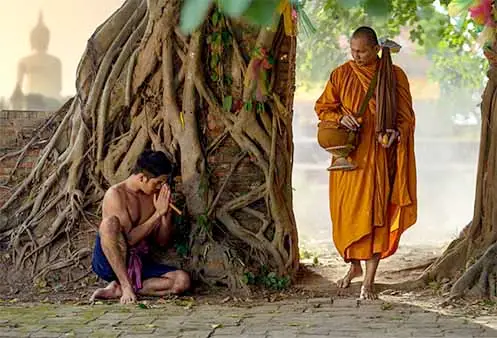
Thailand’s National Geographic article on the topic describes the traditional process, stating: “The steps and methods of tattooing by Thai people, as observed from many temples and institutes, are mostly similar. The first important thing is “paying respect to the teacher.” Every person who will receive a tattoo must prepare a flower tray, incense, candles, money to pay respect to the teacher, and nowadays, there may be cigarettes or energy drinks, dedicating themselves to being a disciple of the tattoo master first.” (1)

Historical documentation also describes ceremonies for paying respect to tattoo masters. One source states: “As for paying homage to the tattoo master of each institute, it is popular to do so during the 7th month (around April) on Phaya Wan day or the 9th month (around June). In the case of Chiang Mai, the tattoo institutes prefer to perform the paying homage to the master after the traditional ceremony of putting flowers in a bowl to worship the Inthakhin pillar in the 9th month is finished” (11).

These references to particular dates reflect traditional community practices from periods when people generally lived closer to tattoo masters and had more regular access to them. Today, the timing and form of these practices can vary between Masters, locations, and individual traditions.

The offering traditionally includes items such as a flower tray, incense, candles, and, depending on the particular tradition and period, cigarettes, energy drinks, and money. The offering serves as a gesture of respect toward the teacher and the tradition. In the traditional context described by National Geographic, making the offering also represents a person’s intention to become a disciple of the tattoo master and to follow the principles associated with that relationship (1).

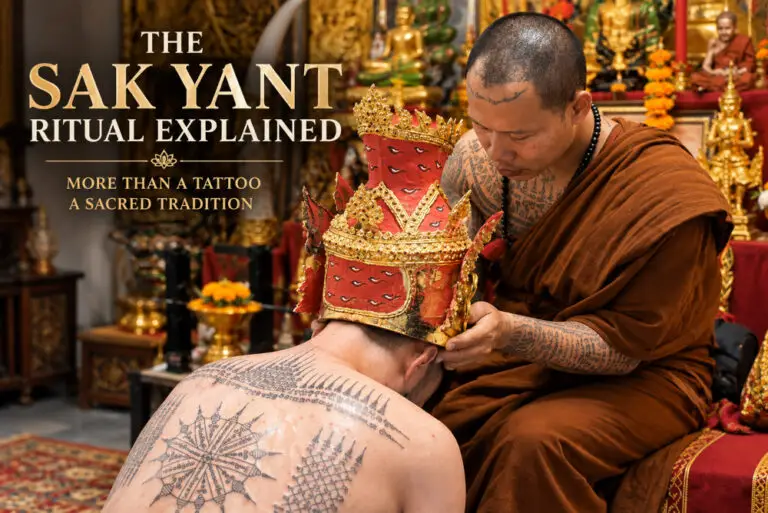
2 The Blessing: Activation of the Magical Text with Prayers and Mantra.  Generally the Sak Yant Master will silently recite the magical mantra as they are creating the Traditional Thai Tattoo, and finalize it after completion to activate the mantras.

In the writings of Sak Yant instruction by two Monks (Phra Athikan Attharo and Phra Maha Wirot Kuttawiro, 2566) they say that the Master must “With the chanting of a spell, every time a yantra is tattooed, teachers and masters are required to protect and preserve. The person who gets the tattoo must have faith and devotion. Respect, obey and follow the teachings of teachers and must have morality. Practice according to the principles of Buddhist teachings”

With consistency in Sak Yant lore, the reciting of Mantra by the Sak Yant Master is also repeated by Monks  Athit Attharo and Maha Wirot in their book ‘The Brave One’ (12) where they instruct “When inking a yantra, if the yantra has a mantra attached to it, then the mantra must be recited at the same time as inking the yantra. Therefore, a high level of concentration is required. As for the steps of inking the yantra, it will be done according to what has been learned from teachers who have imparted knowledge according to the guidelines of each school”.

After the completion of the Sak Yant – the Blessing is conducted verbally where the Sak Yant Master Blessed and activates the mantra they have been intentionally projecting into the Tattoo.

The silent reciting of mantra as the tattoo is inked requires not only concentration, but also the spiritual purity and respect for the Buddhist lifestyle.  Anyone who has experienced getting a Tattoo in a Tattoo Shop, being allowed to play on their phones, while the tattooist chats with others, or listens to music as they preform the tattoo .. has experienced exactly the opposite of how a real Sak Yant is performed.

4) There is no such thing as a Bamboo Needle or Bamboo Tattoo

Historical and academic sources indicate that traditional Sak Yant tattooing was generally performed using metal tools rather than bamboo needles. Before the modern era of machine tattooing in Thailand, traditional Sak Yant was primarily practiced as a spiritual and ritual form of hand-poked tattooing, often associated with Buddhist Monks and other trained practitioners.

Metalworking was well established in Thailand, and Monks had access to refined metals used for religious objects, vessels, statues, and sacred implements. Historical descriptions of Sak Yant tools consistently refer to metal rods or needles, including the Khem, a traditional tattooing rod (13).
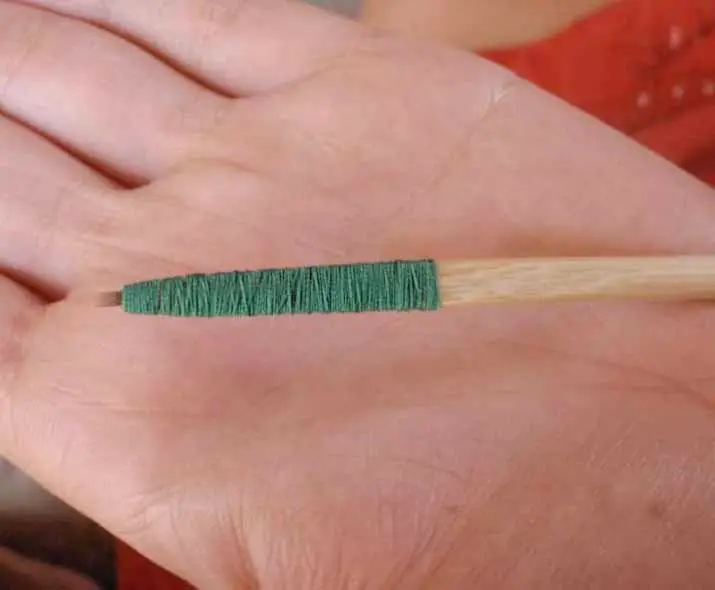
Fake Sak Yant Bamboo Tattoo NeedleBamboo is sometimes associated with modern “bamboo tattoo” terminology, but the historical evidence for its use in traditional Sak Yant appears limited. One documented reference describes prisoners using bamboo as a tattooing tool because other materials were unavailable (1). By contrast, historical descriptions of Sak Yant tattooing repeatedly refer to steel, iron, or other metals as the material used for the tattooing tool (2)(6)(7).

This distinction is also reflected in information provided by practitioners specialising in traditional Sak Yant, including Sak Yant Chiang Mai (5) and Thai Tattoo Chiang Mai (14).

Academic descriptions further support the use of metal tools. One study explains: “Sak Yant tattooing can be divided into two parts. namely The word ‘tattoo’ Refers to the use of a sharp iron rod” (7).

Similarly, Tattoo Culture in Lanna describes the traditional method as follows: “Sak Yant uses a sharp iron or brass object about 3 inches long connected to a wooden or metal handle, for a total length of about 30 – 50 centimeters, called ‘Lek Sam’ or ‘Lek Jar’. The tip of the iron is sharp and has 2 halves joined together to hold ink, tattooing to a depth of about the thickness of 7 betel leaves stacked together” (6).

It is therefore useful to distinguish between a modern tattooing technique marketed as a “bamboo tattoo” and the traditional tools historically associated with Sak Yant. The available historical and academic descriptions point to metal tattooing implements as the established traditional method, rather than bamboo needles.

A bamboo stick may sometimes be provided to visitors as a souvenir or used in modern tattooing terminology, but this should not necessarily be interpreted as evidence that bamboo was the traditional Sak Yant tattooing instrument. Historical accounts instead associate the sacred tattooing tools with the practitioner and their training, rather than treating the tool simply as a souvenir.
Conclusion

Ultimately, the distinction between a traditional Sak Yant and a tattoo inspired by Sak Yant designs is not simply a question of appearance or tattooing technique. Traditional Sak Yant is part of a wider Thai cultural and spiritual practice involving the design, sacred text, the practitioner, traditional methods, offerings, chanting, and blessing. Historical and academic sources consistently describe these elements as important parts of the tradition.

For visitors considering a Sak Yant in Thailand, understanding this distinction allows them to make an informed choice. A commercial tattoo studio may provide a tattoo inspired by Sak Yant imagery, while a qualified Sak Yant Master follows the traditional practices associated with the tradition. Neither choice needs to be judged solely on the basis of the tattoo itself, but it is important to understand what is being offered and the cultural context behind it.

Reference and citations

(1). Thai Tattoos, the symbolic lines of faith  National Geographic. Nov 4 2020. https://ngthai.com/cultures/31619/thai-traditional-tattoos

(2) Why you don’t Get a Bamboo Tattoo at a Tattoo Shop sakyantchiangmai.com Oct 2022 https://sakyantchiangmai.com/sak-yant-bamboo-tattoo/

(3) Study of Thai and Japanese Tattoo. 1996 Nantchaya Mahakhan Burapha University, Faculty of Humanities and Social Sciences   https://buuir.buu.ac.th/xmlui/handle/1234567890/549

(4) Communication and Perception of the Meaning of ‘Tattoos’ in Contemporary Thai Society’,   Faculty of Communication Arts, Chulalongkorn University, by Suksan Kamolsantiroj,   2005     https://cuir.car.chula.ac.th/handle/123456789/8025

(5) What is a Bamboo Tattoo. Sak Yant Chiang Mai  2023   https://sakyantchiangmai.com/bamboo-tattoo-thailand/

(6) Tattoo Culture in Lana  Sept 6 2022. Princess Maha Chakri Sirindhorn Anthropology Centre. Phudech Saensa  https://www.sac.or.th/portal/th/article/detail/371

(7). Sak Yant tattooing as Thai soft power. Department of Public Administration Faculty of Political Science Ramkhamhaeng University.  Krissada Promvek. And Prachaya Chumnaseaw 2024.  http://www.hurujournal.ru.ac.th/journals/35_1719810573.pdf

(8) Bamboo Tattoo Bangkok. Sak Yant Bangkok 2024. https://sakyant-bangkok.com/bamboo-tattoo-bangkok/

(9) What is a Sak Yant Tattoo. 2022 Sak Yant Chiang Mai https://sakyantchiangmai.com/what-is-a-sak-yant-tattoo/

(10) Pansa Khrueaklai and Noppadol Inchan, 2002, p. 73)

(11) Chuanphit Naphatasaai (editor), Dhammatharo Achariyanuson, (cited), page 49.

(12) Book The Brave One. (Phra Athit Attharo and Phra Maha Wirot , 2566)

(13) Tourist Bamboo Tattoo vs Real Sak Yant. Youtube Video  https://www.youtube.com/watch?v=-HogMIhYYz8

(14) The Story of the Bamboo Tattoo Needle. Thai Tattoo Chiang Mai.  https://thaitattoochiangmai.com/2016/08/28/bamboo-sak-yant-needles/

(15) Thailand To Tattoo Tourists: Think Before You Ink NPR Radio June 20, 2011