History of the Sak Yant Tattoo
What Does Sak Yant Mean?
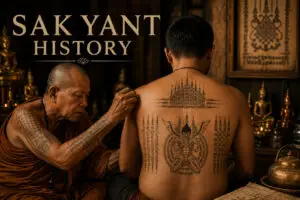
The Thai expression Sak Yant is generally understood as referring to tattooing sacred yantra designs. The word sak means “to tattoo” in Thai, while yant derives from the Sanskrit word yantra, referring to a sacred diagram, instrument or symbolic design used within religious and ritual traditions. [1]
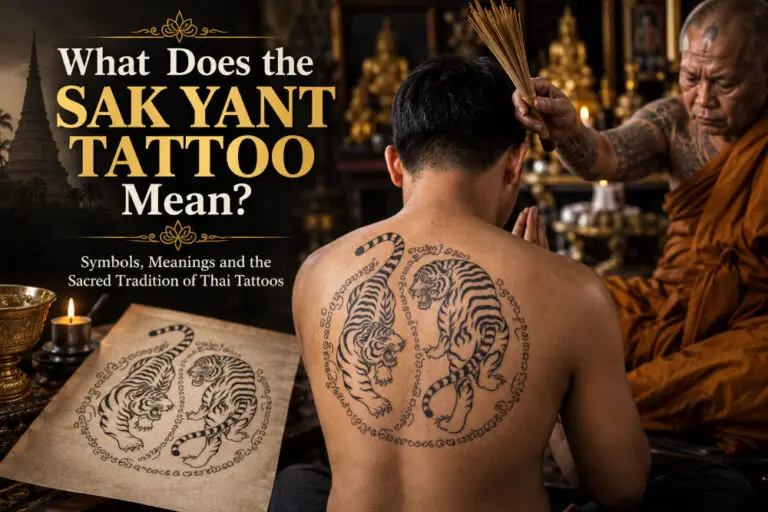
A Sak Yant is therefore more than a decorative image placed on the skin. Traditionally, the design forms part of a wider spiritual practice involving sacred geometry, inscriptions, chanting, ritual and blessing. The tattoo may contain geometric patterns, animals, divine figures or other symbolic forms, together with sacred syllables or verses.
This distinction is important when considering the history of Sak Yant. The tradition is not simply the history of tattooing in Thailand. It is the history of how tattooing became connected with older systems of sacred geometry, spiritual protection and religious practice in mainland Southeast Asia.
The Ancient Roots of Sak Yant
The earliest history of Sak Yant is difficult to establish with certainty. Tattoos are placed on skin, meaning that unlike stone inscriptions, manuscripts or temple architecture, they rarely survive for archaeologists to examine. Academic research therefore cautions against presenting a precise origin date for the tradition. [2]
What can be identified is a combination of older traditions. Angela May’s research into Sak Yant describes the practice as developing from the interaction of Indian yantra traditions, Southeast Asian animist beliefs and Buddhist practices. [3]
In mainland Southeast Asia, these ideas encountered existing local beliefs concerning spirits, protection, supernatural forces and the relationship between human beings and the natural world. Rather than replacing those traditions, Hindu and Buddhist concepts became incorporated into them.
The result was not a single uniform system. Different regions developed different combinations of symbols, sacred languages and ritual practices. The Sak Yant tradition that exists today is therefore better understood as the result of centuries of cultural development rather than the invention of a particular historical individual.
The Khmer Empire and the Development of Yantra Traditions
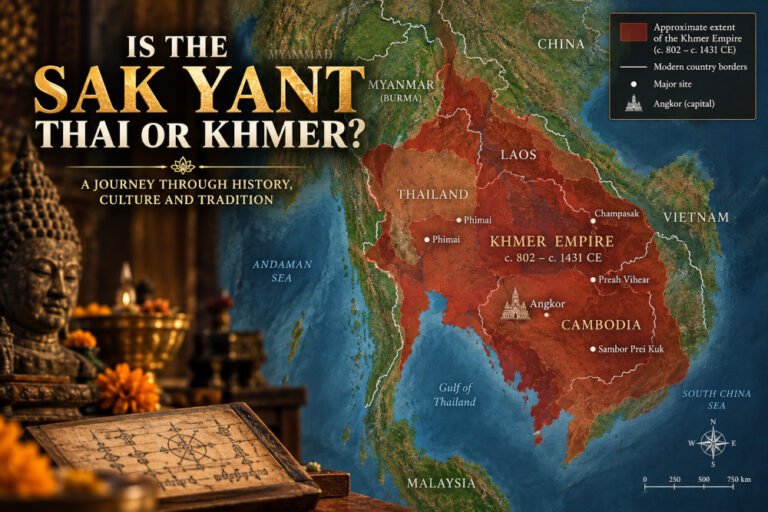
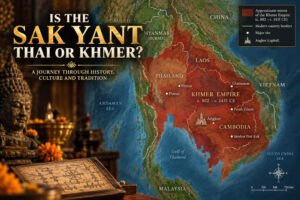
Many accounts of Sak Yant connect its early development with the Khmer Empire, which dominated large areas of mainland Southeast Asia between approximately the ninth and fifteenth centuries. The cultural influence of the Khmer world extended well beyond the territory of present-day Cambodia, reaching areas that are now part of Thailand, Laos and other neighbouring regions. [1]
The connection with the Khmer world is particularly important because of the scripts used in many traditional yantra designs. Old Khmer and related Khom forms of writing became important for recording religious and magical texts throughout the region.
The modern political borders between Thailand and Cambodia did not exist during much of this period. For that reason, describing Sak Yant as exclusively “Thai” or exclusively “Cambodian” can oversimplify its history. The tradition developed in a cultural landscape where people, religious ideas, languages and political territories crossed what are now international borders.
The Sak Yant Chiang Mai historical account similarly describes the tradition as developing before the modern nations of Thailand and Cambodia existed and becoming integrated into the different cultures of the region over time. [4]
This shared history helps explain why Cambodian and Thai sacred tattoos can contain related geometric structures, sacred inscriptions and symbolic figures, while still displaying important regional differences. or a more detailed explanation read Is the Sak Yant Thai or Khmer
Sak Yant and Warriors
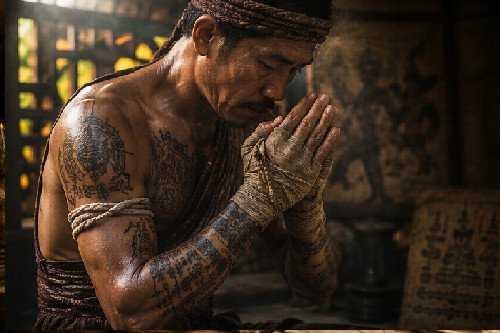 The association between sacred tattoos and warriors is one of the most persistent elements in the history of Sak Yant.
Throughout Southeast Asia, tattoos have historically been associated with protection, identity and status. In the traditional Sak Yant worldview, a tattoo could function much like a permanent amulet, providing the wearer with spiritual protection and qualities believed to be useful in dangerous situations.
Accounts of the Thai tradition associate sacred tattoos with soldiers and warriors, who sought protection before entering battle. Some traditions describe tattoos and sacred tattooed garments being used as protective talismans. [4]
The idea nevertheless remained influential. Designs depicting tigers, Hanuman and other powerful figures became associated with qualities such as courage, strength, fearlessness and resilience.
The Evidence from Thailand
Much of the history of Sak Yant Tattooing comes from Thailand. Cambodia records and knowledge was largely destroyed during the Khmer Rouge reign and their destruction of anything intellectual or academic.
The history of sacred tattooing in Thailand becomes easier to discuss as written records and surviving cultural evidence become more available. Thai academic research notes that sacred tattooing was associated with protective beliefs and was particularly important among groups such as soldiers. Research also describes the later development of tattooing as an identity marker and the changing social attitudes toward tattooed people. [5]There are also important visual clues in Northern Thailand. Historical Lanna religious art includes representations of tattooed men, providing evidence that tattooing was part of the cultural landscape of Northern Thailand centuries ago.
Such evidence is valuable because it demonstrates that tattooing was not a recent import into Thailand. It was part of wider traditions of body marking that developed alongside religious, social and political changes in the region.
The Role of Monks and Religious Teachers
 The relationship between Sak Yant and Buddhism developed gradually. Sak Yant should not be understood as a practice that began exclusively within Buddhist monasteries. Earlier Southeast Asian spiritual traditions already included tattooing, protective magic and beliefs concerning spirits and supernatural forces.
As Buddhism became deeply established throughout the region, however, Buddhist concepts, texts, symbols and ritual practices became incorporated into sacred tattooing.
Monasteries also became important centres of literacy and religious learning. Monks were among the people able to preserve and transmit sacred texts, ritual knowledge, astrology, numerology and other forms of traditional knowledge.
Over generations, individual teachers developed their own bodies of knowledge. Students learned designs, sacred texts, chants and ritual practices from their teachers, creating the lineages that remain important in Sak Yant today. [4]
In Thailand, the word Ajarn is commonly used for a respected teacher or master. Some Sak Yant practitioners are Buddhist Monks, while others are lay spiritual masters who have received instruction within a particular lineage.
The Sacred Languages of Sak Yant
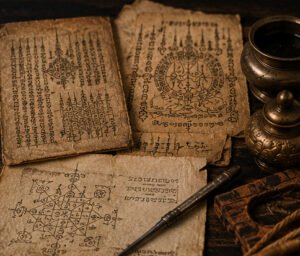 One of the most recognizable features of Sak Yant is the writing surrounding or incorporated into the designs.
These inscriptions are often written in forms of Pali, Khom or regional scripts rather than ordinary modern Thai. The exact script can vary according to geography and lineage. Central Thai traditions have historically made extensive use of Khom, while Northern Thai traditions can include Lanna, Tai and other regional writing systems. [1]
To someone unfamiliar with the tradition, these inscriptions can look like a secret language. In many cases they are not intended to be read like an ordinary sentence. They may represent abbreviated sacred syllables, Buddhist formulas, mantras or other forms of ritual text.
The Sak Yant Chiang Mai historical account describes Pali, Khom and Lanna traditions as important parts of the sacred language of Sak Yant and explains that the precise interpretation can vary according to the lineage and accompanying chant. [4]
The Importance of Ritual
Historically, the power attributed to a Sak Yant has not depended solely on the appearance of the tattoo.
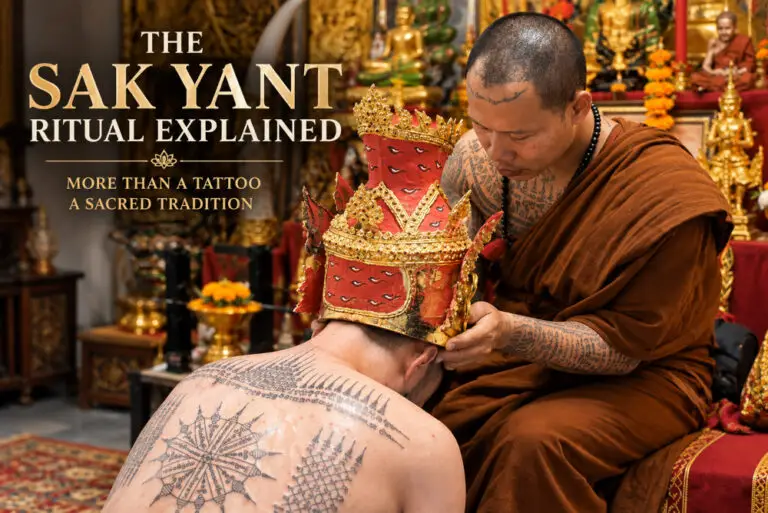
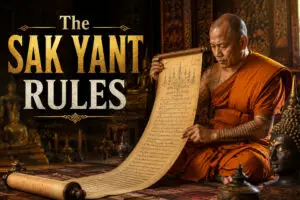
Traditional practice can include an offering, preparation, sacred chanting, application of the design and a blessing by the practitioner. The ritual surrounding the tattoo is therefore part of what distinguishes a traditional Sak Yant from a purely decorative reproduction of a yantra design.
The belief is that the tattoo becomes spiritually significant through the relationship between the design, the sacred text, the practitioner, the ritual and the person receiving it. [4]
This also explains why traditional Sak Yant traditions may include rules of conduct. Different masters and lineages have different requirements, but these can include moral behaviour, respect for parents and teachers, avoidance of certain actions and adherence to Buddhist principles. [1]
The Development of Sak Yant Lineages
As the tradition spread throughout mainland Southeast Asia, different regions and teachers developed distinctive approaches to designs, inscriptions and ritual. Geographic isolation was particularly important before modern transportation and communication. A teacher in one region might preserve a particular collection of designs and sacred texts that differed from those of a teacher many hundreds of kilometres away.
These bodies of knowledge were passed from teacher to student. Over time, the relationship between teacher and student became one of the foundations of Sak Yant lineage. [4] Some modern lineages can trace their teachings through named Monks and Ajarns over several generations. Others such as Wat Bang Phra represent a mixture of older regional traditions that have been brought together through travel and study over the last 50-120 years.
This diversity is one reason there is no single “Sak Yant design book” that represents the entire tradition. The designs, scripts and rituals can vary considerably between Northern Thailand, Central Thailand, Laos and Cambodia. Lineage has taken on an importance in central Bangkok and Southern Thailand due to a lack of historical transition and history. Many Ajarns of the 75 years of Wat Bang Phra teachings rely heavily on it as a means of credibility and authenticity. In the North with 800-900 years of shared knowledge the lineage is mixed and not so important
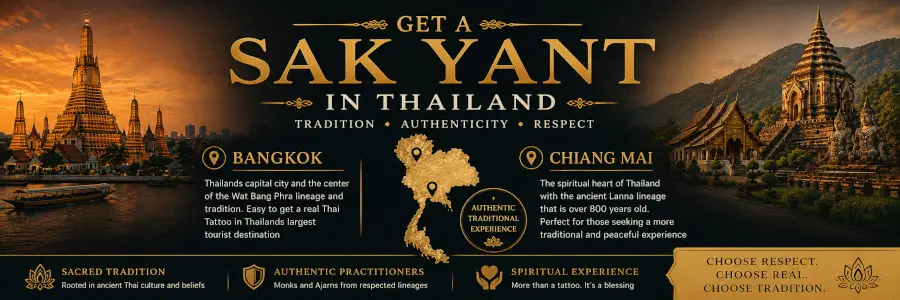
Northern Thailand 900 Year Old Lanna Lineage
Northern Thailand has its own distinctive history of sacred tattooing. The former Lanna Kingdom developed cultural and religious traditions that differed in important ways from those of Central Thailand. Lanna sacred traditions incorporated regional scripts and forms of Buddhist, animist and Hindu-influenced knowledge. These traditions remain visible in the designs and inscriptions used by some Northern Thai Sak Yant practitioners today.
This regional history is particularly relevant to Chiang Mai. The city was the historic centre of the Lanna Kingdom and remains an important location for the preservation and practice of Northern Thai sacred tattoo traditions. The existence of regional variations demonstrates why Sak Yant should not be viewed as a single standardized tattoo style. It is a living tradition with multiple historical streams.
The Global Popularity of Sak Yant – Angelina Jolie
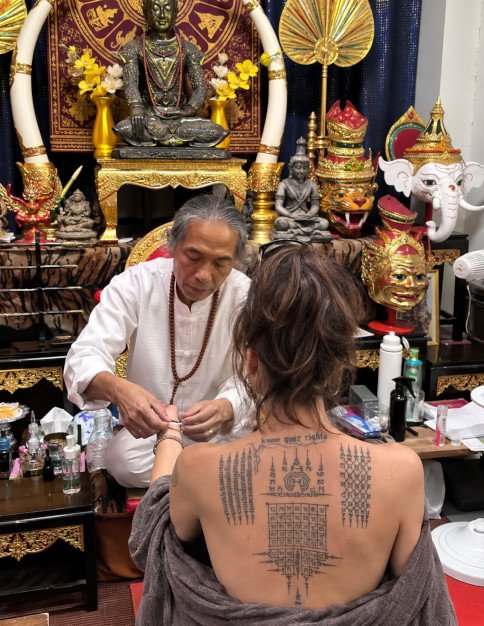 In the twenty-first century, Sak Yant moved from a relatively specialized Southeast Asian religious practice into the international tattoo community. International travellers began visiting temples and individual masters specifically to receive traditional tattoos. Photographs and documentaries helped introduce Sak Yant to audiences outside Thailand.
The tattoos of international celebrities also contributed to this visibility. Angelina Jolie’s Sak Yant tattoos, for example, attracted considerable international attention and introduce the tradition to a much wider audience. [1]
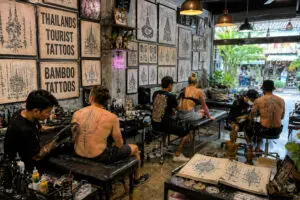
This international popularity has brought both opportunities and challenges. More people are interested in learning about the tradition, but the rapid growth of tourism has also created confusion between a traditional Sak Yant and a modern “Bamboo Tattoo” that simply copies the appearance of a yantra design.
Sak Yant Today
Sak Yant remains a living tradition rather than simply a historical form of tattooing. Monks and Ajarns continue to teach designs, sacred texts and rituals to new generations. At the same time, the tradition continues to change. Modern practitioners may work with people from different countries, traditional designs are shared more easily through books and the internet, and younger generations may understand sacred tattoos differently from their grandparents.
Research into contemporary Thai sacred tattooing suggests that globalization has not simply erased the traditional meaning of Sak Yant. Instead, traditional beliefs and modern ideas about identity, culture and personal expression now exist alongside one another. [6]
This is perhaps the most important point when considering the history of Sak Yant: the tradition has never been completely static. It has changed as people, religions, kingdoms, languages and cultures have interacted across Southeast Asia.
What the History of Sak Yant Tells Us
The history of Sak Yant is ultimately a history of cultural exchange.
Ancient Indian concepts of sacred geometry became part of the religious world of Southeast Asia. Local animist beliefs about spirits and protection became integrated with Hindu and Buddhist ideas. Khmer cultural influence helped shape scripts and sacred knowledge. Thai and Lanna traditions then developed their own forms, with Monks and Ajarns passing knowledge through generations.
The modern Sak Yant is the result of this long process.
It is also why a traditional Sak Yant cannot be understood simply by looking at the finished tattoo. The design is only one part of a much larger tradition involving sacred language, symbolism, ritual, teacher lineages and the beliefs of the person receiving it.
While some claims about the ancient history of Sak Yant remain impossible to prove, the broader historical picture is clear. Sacred tattooing in mainland Southeast Asia has deep roots, and the tradition that became known as Sak Yant has developed through centuries of interaction between Indigenous beliefs, Indian yantra traditions, Hinduism and Buddhism.
Today, Sak Yant continues that history. Every traditional tattoo represents not only an image placed on the skin, but a connection to a body of knowledge that has been transmitted, adapted and reinterpreted across generations.
Sak Yant References and Further Reading
- Wikipedia, “Yantra tattooing.” Overview of the history, terminology, scripts, meanings and regional development of Sak Yant and yantra tattooing.
https://en.wikipedia.org/wiki/Yantra_tattooing - Khuanmuang, Chariti. “Sacred Tattoos: Construction of Identity.” Journal of Multidisciplinary in Social Sciences, Vol. 16, No. 2. This study notes the difficulty of establishing a precise historical origin for Thai sacred tattooing and examines the development of sacred tattoos in contemporary Thailand.
Journal of Multidisciplinary in Social Sciences - May, Angela Marie. “Sak Yant: The Transition From Indic Yantras To Thai ‘Magical’ Buddhist Tattoos.” Master’s Thesis, University of Alabama at Birmingham, 2014. May examines the relationship between Indic yantras, animism and Buddhism in the development of Sak Yant.
University of Alabama at Birmingham Digital Commons - Sak Yant Chiang Mai, “History of Sak Yant Tattoos: Origins, Culture & Meaning.” A detailed account of the historical development of Sak Yant, including Khmer influence, sacred languages, Buddhism, warrior traditions, lineages and the development of Thai Sak Yant.
Sak Yant Chiang Mai - “Meaning Alteration of Thai Sacred Tattooing.” Research examining the changing meanings, purposes and social context of sacred tattooing in Northern Thailand, including the influence of globalization and changing attitudes toward tattoos.
Journal of Social Sciences - Khuanmuang, Chariti. “Sacred Tattoos: Construction of Identity.” The study examines how sacred tattoos in contemporary Thailand have moved between religious, magical, cultural and fashion-oriented meanings while retaining elements of traditional practice.
Journal of Multidisciplinary in Social Sciences - Cummings, Joe and Dan White. Sacred Tattoos of Thailand: Exploring the Magic, Masters and Mystery of Sak Yan. Marshall Cavendish, 2011. A major English-language reference examining Sak Yant masters, traditions, designs and historical development.
- Drouyer, Isabel Azevedo and René Drouyer. Thai Magic Tattoos: The Art and Influence of Sak Yant. River Books, 2013. A detailed study of the artistic and cultural traditions surrounding Thai sacred tattoos.
- Krutak, Lars. Spiritual Skin: Magical Tattoos and Scarification. Reuss. Anthropological documentation of traditional tattooing practices, including sacred tattoo traditions in Southeast Asia.