![]()
Is the Sak Yant Thai or Khmer?
Is the Sak Yant Thai or Khmer? The Origins of Sacred Tattooing
When someone researches the Sak Yant Tattoo, often times they will find in the comments from Cambodian citizens about how Thailand stole the Sak Yant Traditions, or that a real Sak Yant is written in Khmer. So Did Thailand take Sak Yant from Cambodia, and must an authentic Sak Yant be written in Khmer? The short answer is no.
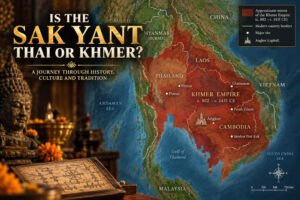
The history of the development of the Sak Yant started in India around 1st millennium CE, and was developed and spread by the Khmer Empire in the 8th century. As the Khmer empire fell in 13th–15th centuries and shrunk in size the traditions of both the Ancient Khmer Language being used for Buddhist religious text and the cultures of the people lost to empire changes stayed similar. From the 13th century as language forms developed, religious scripts (including the Sak Yant) added Khom Tai, Laos, Lanna and other scripts, just as Khmer was used to replace Pali during the Khmer Empire.
Why Do Cambodian and Thai People Argue So Strongly about the Sak Yant Today?
The simple answer lies in modern nationalism. It is important to note that Sak Yant masters themselves, nor academics make any claim as to ownership or stolen traditions. These “Is the Sak Yant Thai or Khmer” claims are exclusively made by lay citizens usually as part of of their personal ideology and narrative as to the importance of their national pride.
Cambodia Violent History – Lost Land and Culture.
Cambodia has a violent history from the heights of the Khmer Empire around the 8th century to the modern nation of Cambodia which was formed during 1863 as a protectorate of France. The French occupation ending centuries of regional decline and shifting borders. In 1953, King Norodom Sihanouk successfully led the country to full national independence. 1975 saw the rise of the Khmer Rouge, and finally in 1993 A new constitution restored the monarchy, forming today’s modern constitutional government.
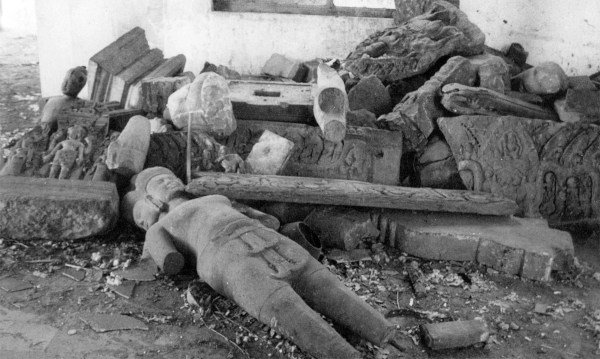
During each transition but especially the Khmer Rouge period from 1975 to 1979 severely disrupted Cambodia’s religious, educational and cultural institutions. Monks, teachers, academics Sak Yant Masters and other educated people were targeted, while temples, religious objects and cultural records were destroyed or repurposed. This caused significant disruption to the transmission of traditional knowledge.
After the Khmer Rouge, Cambodia had to rebuild much of its cultural heritage using surviving local traditions, manuscripts, oral histories and records preserved elsewhere. For traditions such as dance, costumes and sacred tattooing, Thai sources and surviving Thai practices provided useful and predominant comparative information because these traditions developed across a wider regional cultural environment.
Today, cultural heritage is closely connected to national identity in both Cambodia and Thailand, which can contribute to competing claims about origins and ownership. However, these claims need to be considered individually against historical, archaeological and academic evidence. In the case of Sak Yant, the evidence points to centuries of interaction between Khmer, Thai, Lao and other Southeast Asian traditions rather than exclusive ownership by either modern country.
The situation regarding the Sak Yant is predominantly the Cambodians focusing on Thailand and not Laos or other traditions of Sak Yant. This is perhaps because of a heavy reliance of migrant workers from Cambodia to Thailand, where they are not given equal status and this tensions spills over into National pride, of which the Sak Yant holds a high value in each country.
The History of Sacred Tattooing in Thailand and Cambodia
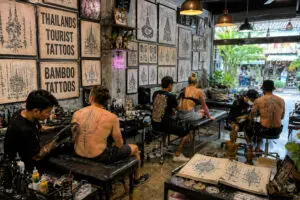
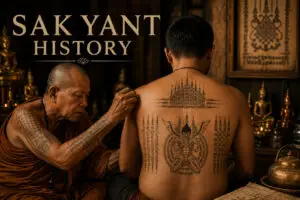
Sak Yant is now one of the most recognizable forms of sacred tattooing in Southeast Asia. Visitors from around the world travel to Thailand to receive Sak Yant tattoos from Buddhist monks and Ajarns, and the practice has become particularly associated with Thai Buddhist temples, masters and spiritual traditions.
The origins of Sak Yant are best understood as a series of overlapping developments rather than a single invention at a particular moment. Starting in India, through the Khmer Empire and as the empire collapsed into other (mostly) Thai based traditions
Ancient India
Development:
Yantra, mantra and sacred geometry develop.
Evidence:
Religious and textual traditions.
Early 1st millennium CE
Development:
Indic religious traditions spread into mainland Southeast Asia.
Evidence:
Archaeological and historical evidence.
c. 8th century
Development:
Yantra-related tattooing is proposed in the Khmer cultural sphere.
Evidence:
Academic interpretation, not surviving tattoo evidence.
Khmer Empire
Development:
Khmer writing becomes an important vehicle for religious texts.
Evidence:
Inscriptions and manuscripts.
13th–15th centuries
Development:
Sukhothai and later Thai Buddhist traditions develop.
Evidence:
Inscriptions, manuscripts and art.
Late Sukhothai–early Ayutthaya
Development:
Some formulas associated with present-day Sak Yant are documented as having very old local histories.
Evidence:
Scholarly research.
Lanna period
Development:
Northern traditions develop their own script and ritual characteristics.
Evidence:
Manuscripts and regional traditions.
19th–early 20th century
Development:
Tattooing remains widespread in Thailand and neighbouring societies.
Evidence:
Historical and ethnographic research.
20th century
Development:
Modern forms of Thai Sak Yant become increasingly recognizable.
Evidence:
Ethnographic and historical research.
21st century
Development:
Sak Yant becomes internationally known as a Thai-associated spiritual tattoo tradition.
Evidence:
Contemporary scholarship.
Before Sak Yant: The Older Yantra Tradition
The history of Sak Yant does not begin with the Thai word “Sak Yant.” The underlying concept of the yantra is considerably older and has roots in the religious traditions of South Asia. Yantras developed as sacred diagrams associated with religious practice, meditation, ritual and the manipulation or focusing of spiritual power. Yantras could be created on temporary surfaces, metal plates, manuscripts and other materials, and they could also be incorporated into architecture, religious objects and ritual practices.
The importance of yantra traditions to the history of Sak Yant is significant because many of the geometric principles and ideas surrounding sacred diagrams predate the emergence of the modern Thai kingdoms. Angela Marie May’s 2014 master’s thesis, Sak Yant: The Transition From Indic Yantras to Thai “Magical” Buddhist Tattoos, examines this development and argues that modern Thai Sak Yant represents a transformation of older Indic yantra traditions through Buddhist, Hindu and animist practices in Thailand.
How Did Yantra Traditions Reach Southeast Asia?
Scholars generally connect the spread of yantra and related religious technologies into Southeast Asia with the movement of Indian religious ideas, texts, merchants, monks and religious specialists. These traditions did not arrive in a ready-made form and remain unchanged. They became incorporated into the religious cultures of societies throughout mainland Southeast Asia.
Hindu and Buddhist ideas interacted with existing local beliefs concerning spirits, protection, fertility, warfare, authority and supernatural power. The result was not a single uniform system but a collection of related traditions. This helps explain why sacred diagrams and magical formulas with similar underlying concepts can be found across Cambodia, Thailand, Laos and other parts of the region while still displaying significant local differences.
The Khmer Empire Was Larger Than Modern Cambodia
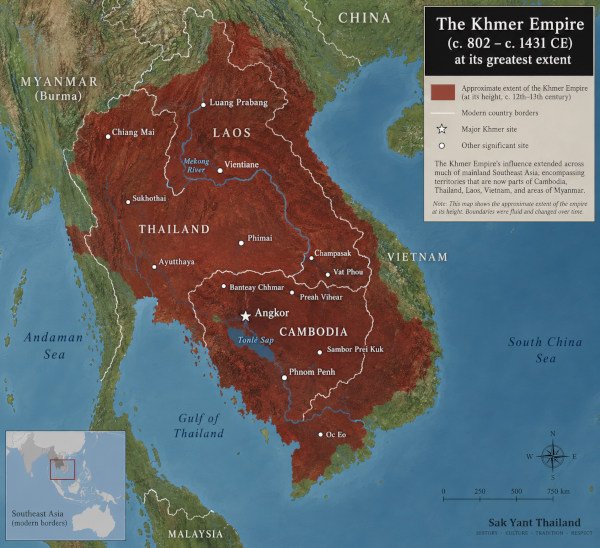
Another problem arises when the history is described using modern national boundaries. The Khmer Empire was a major political and cultural power in mainland Southeast Asia, and its influence extended over territories that are now located within several modern countries.
Consequently, saying that a tradition developed “in Cambodia” can be misleading if the statement is intended to mean the territory of the modern Cambodian nation-state. A more historically precise description is “the Khmer cultural sphere” or “the Khmer Empire.”
The same problem occurs when attempting to describe traditions as exclusively Thai. The cultures of the region were interacting long before Thailand and Cambodia existed as modern nation-states with their present borders. Religious practices, scripts, artistic styles, magical formulas and Buddhist traditions moved between communities.
Khmer Writing and the Khom Tradition of the Sak Yant Tattoo
One of the strongest reasons for the modern belief that Sak Yant must be Khmer concerns writing. Many traditional yantra designs contain writing that looks distinctly Khmer. There is a very good historical reason for this. Khmer writing had a major influence on the development of scripts used in mainland Southeast Asia. In Thailand, a related tradition became known as Khom. Khom became particularly important in Buddhist manuscripts and religious writing.
However, calling the script “Khmer” and calling the language “Khmer” are not necessarily the same thing. This distinction is extremely important. Research into manuscripts from Thailand and Cambodia shows that Pali Buddhist texts were written using Khom and related Khmer-derived scripts. Javier Schnake’s study of Khom and Mūl manuscripts demonstrates that both Khmer and Tai communities used these scripts for Buddhist texts.
His research also identifies an important distinction in Thai manuscript practice. Khom Bali was used for Pali, while Khom Thai was used for Thai-language material. The same manuscript could therefore contain different languages and different uses of closely related scripts. This means that a tattoo containing Khom-style characters is not automatically written in the Khmer language. It may contain Pali, Thai, sacred syllables or abbreviated formulas, and it may also contain Khmer. The script alone cannot establish the language.
Pali, Not Khmer, Is Often the Important Language for Sak Yant Tattoos
Pali is the liturgical language of Theravada Buddhism and has been used throughout the Buddhist cultures of mainland Southeast Asia. Pali texts have been written in many different scripts. In Thailand and Cambodia, Pali was historically written using Khmer-derived scripts as well as other regional writing systems.
A study of Khom manuscripts found in Thailand and Cambodia demonstrates that Pali Canon manuscripts were copied in Khom script in both countries over many centuries. Another study of a Thai manuscript from the Ayutthaya period demonstrates that Khom-Yor script was specifically used to record Pali. This provides an important historical explanation for what people see on many Sak Yant tattoos. The letters may look Khmer because the script belongs to a Khmer-derived writing tradition, but the underlying text may be Pali.
Khmer-derived script does not automatically mean Khmer language. Khmer-derived script does not automatically mean Cambodian origin. The history of Khom in Thailand is itself centuries old.
The Sukhothai and Ayutthaya Periods
The next major question is whether there is evidence for these traditions within the historical development of Thailand. The answer is yes, although the evidence is not a continuous photographic record of tattooing.
Specific magical formulas associated with Sak Yant have been identified as having been known locally for centuries, with some evidence placing their use at least as far back as the late Sukhothai or early Ayutthaya periods. This is important because it demonstrates that some formulas associated with modern Sak Yant are not recent inventions created for the modern tourism industry.
At the same time, it would be incorrect to imagine that a single standardized Sak Yant system existed in the Sukhothai period exactly as it appears today. Modern Sak Yant is the result of a long process of development. Designs, formulas, ritual practices, scripts and interpretations have changed, and different masters and regional lineages have also preserved different traditions.
Lanna and Northern Thailand
Northern Thailand provides another important reason why the idea that every Sak Yant must be written in Khmer is difficult to support. Northern Thailand developed distinctive religious and literary traditions associated with Lanna and neighbouring Tai cultures.
Northern sacred tattooing therefore developed within a different cultural environment from some central Thai traditions. Research into Thai sacred tattooing in northern Thailand has documented the changing meanings of the practice and its relationship with social, economic and religious changes.
The existence of regional variation is not a modern phenomenon. It is one of the characteristics of the tradition itself. A Sak Yant master in northern Thailand does not necessarily belong to precisely the same textual or ritual lineage as a master in central Thailand. Consequently, there is no single historical script that can be used as a universal test of authenticity.
Is the Traditional Sak Yant Thai or Khmer?
Did Thailand Steal Sak Yant From Cambodia?
The evidence does not provide a straightforward answer of “yes.” There is substantial evidence for Khmer influence on the religious and magical traditions from which modern Sak Yant developed, and there is also evidence that Khmer-derived writing became an important part of Thai religious culture.
But this is not the same as demonstrating that Thailand took a fully formed Cambodian tradition and simply renamed it. The historical evidence instead points toward centuries of cultural interaction. Khmer, Thai, Lao and other societies existed within overlapping religious and cultural networks, while people, manuscripts, religious specialists, artistic conventions and ritual practices crossed political boundaries.
The evidence from manuscripts is especially revealing because the transmission of Khom writing itself was not exclusively one-way. Some researchers have even identified evidence suggesting that certain Khom-script Pali manuscripts in Cambodia were influenced by manuscript traditions from Thailand.
Does an Authentic Sak Yant Have to Be Written in Khmer?
There is no good historical evidence for an absolute rule that an authentic Sak Yant must be written in the Khmer language. There are several reasons.
First, many sacred inscriptions are written in Pali rather than Khmer.
Second, Pali has historically been written using several different scripts.
Third, Khom and related Khmer-derived scripts were used in Thailand for religious writing for centuries.
Fourth, different regions of Thailand developed different sacred writing traditions. Fifth, the meaning and ritual function of a Sak Yant does not depend exclusively on the language or script of its written elements.
The design, sacred formula, ritual activation, lineage, master and associated beliefs can all be significant. Modern scholarship describes the scripts used in yantra designs as varying according to culture and geography, with Pali and Khmer among the common forms. This is consistent with the historical manuscript evidence.
Khmer Script Does Not Mean Khmer Language
This point deserves to be repeated because it is one of the most common sources of confusion. Imagine a Buddhist manuscript in Thailand. It may contain Pali as the language, Khom as the script, Theravada Buddhism as the religious tradition, and Thailand as its place of production or use. Calling the manuscript “Cambodian” simply because the script has Khmer ancestry would be misleading.
The same principle applies to a Sak Yant. A tattoo can contain Pali language + Khom script + Thai ritual tradition without being a Cambodian tattoo. Likewise, a tattoo could contain Khmer language or Khmer-derived ritual material and still exist within a Thai lineage. History is rarely as neatly divided along modern national borders as internet arguments suggest.
Q) Does This Mean Cambodia Has No Claim to Sak Yant?
No. That would be an equally inaccurate conclusion. Cambodia has a genuine and important historical connection to yantra, sacred writing, magical traditions and tattooing. Khmer culture played a major role in the religious history of mainland Southeast Asia.
The Khmer Empire was one of the great cultural powers of the region, and Khmer religious and writing traditions influenced neighbouring societies. There are also living Cambodian traditions of sacred tattooing. Academic and specialist literature documents Cambodian yantra and mantra traditions as an important field of study.
The historical mistake is not recognizing Cambodian influence. The mistake is turning historical influence into exclusive modern national ownership.
Q) The Same Problem Applies to the Claim That Sak Yant Is Exclusively Thai
The opposite argument can also go too far. Sak Yant is undeniably a Thai term and modern Thai Sak Yant is a major living Thai tradition. Thailand has developed distinctive masters, lineages, designs, rituals and interpretations.
But modern Thai Sak Yant did not emerge in complete isolation from the rest of Southeast Asia. It contains elements with Indian, Khmer, Buddhist, Hindu, animist and regional Southeast Asian histories. Recent scholarship describes Sak Yant precisely in these terms, as a tradition that crossed religious and cultural boundaries and developed into a hybrid form.
Therefore, calling modern Sak Yant a Thai tradition is historically reasonable. Claiming that every element of it originated independently within modern Thailand would not be.
Q) Why Do Some People Argue About the Authentic Sak Yant has to be Thai or Khmer So Strongly Today?
Part of the answer lies in modern nationalism. Ancient Southeast Asian cultural history does not fit neatly into today’s political map. A religious practice could have originated in one cultural environment, been modified in another, written using a script developed by a third community, and then become especially associated with a fourth.
Modern national identity encourages people to ask, “Who owns it?” History more often produces the answer, “Several cultures contributed to it, at different times and in different ways.” There is also a difference between cultural origin and modern cultural identity.
Sak Yant can have important Khmer historical roots while simultaneously being an important part of modern Thai culture. These statements do not contradict one another.
What Does the Academic Evidence Actually Support?
There is evidence supporting:
- An ancient Indic background to yantra traditions.
- The transmission of yantra and related religious concepts into Southeast Asia.
- A significant Khmer cultural connection to the development of yantra and sacred tattoo traditions.
- The use of Khmer-derived scripts in Buddhist and magical traditions.
- The long use of Khom writing in Thailand.
- Pali being written in Khom script in both Thailand and Cambodia.
- The existence of sacred tattooing traditions in Thailand.
- The existence of distinct regional Thai traditions.
- The survival of formulas associated with modern Sak Yant for several centuries.
- Continuing cultural exchange between Thailand and Cambodia.
There is not good evidence supporting:
- The proposition that Sak Yant must always be written in the Khmer language.
- The proposition that Khmer script necessarily means the tattoo is Cambodian.
- The proposition that all modern Sak Yant was simply copied from Cambodia.
- The proposition that Thailand and Cambodia had completely separate sacred tattoo traditions.
- The proposition that modern national borders can be used to determine ownership of traditions that developed before those borders existed.
Conclusion
The question “Is Sak Yant Cambodian or Thai?” has no historically satisfactory one-word answer. Cambodia and the Khmer cultural world played an important role in the history of sacred yantra traditions in mainland Southeast Asia. Khmer writing also became an important vehicle for sacred Buddhist and magical texts.
Thailand subsequently developed its own long-standing traditions of sacred tattooing, including the practices now widely known as Sak Yant. The evidence does not demonstrate that Thailand simply stole a fully formed Cambodian tradition. Nor does it support the idea that Sak Yant developed independently of Khmer and other Southeast Asian traditions.
Most importantly, there is no historical basis for an absolute rule that a genuine Sak Yant must be written in the Khmer language. Many traditional sacred formulas are Pali. Pali was historically written using Khom, a Khmer-derived script, as well as other scripts. The use of a Khmer-derived script therefore cannot by itself establish either the language or the national origin of a tattoo.
The history of Sak Yant is better understood as a history of transmission, adaptation and regional development. It is a tradition whose roots reach beyond modern Thailand, whose development involved Khmer and other Southeast Asian cultures, and whose modern form has become deeply associated with Thai religious and cultural life.
That history does not diminish either Cambodia or Thailand. It makes the history of Sak Yant considerably more interesting.
References
1. May, Angela Marie. Sak Yant: The Transition From Indic Yantras to Thai “Magical” Buddhist Tattoos. Master’s thesis, University of Alabama at Birmingham, 2014.
2. Jerrentrup et al. “The Body, the Spirit, and the Other: Yantras as Embodied Cultural Integration.” Social Sciences, 13(1), 34, 2024.
3. Schnake, Javier. “Khom/Mūl Script Manuscripts from Central Thailand and Cambodia: Colophons with a Variable Geometry?” In The Syntax of Colophons: A Comparative Study across Pothi Manuscripts, Studies in Manuscript Cultures, vol. 27, 2022, pp. 209–228.
4. Srisetthaworakul, Suchada. “A Problem on the Origin of the Pāli Canon of Khom Script Manuscripts: Found in Thailand and Cambodia.” Journal of Indian and Buddhist Studies, 66(3), 2018, pp. 1038–1044.
5. Laksanasiri, Jurairat, and Yanyong Sikkharit. “The Khom-Yor Scripts in Prince Thamthibet Chaiyachetsuriyawong’s ‘Nanthopananthasut Kham Luang’ Thai Manuscript.” Journal of the Faculty of Arts, Silpakorn University.
6. Revire, Nicolas, and Javier Schnake. “Namo Buddhāya: A Scarified and Puzzling Buddha Image from Northeast Thailand.” Journal of the Siam Society, 111(1), 2023, pp. 57–74.
7. Jantawong, Wichitra. “Meaning Alteration of Thai Sacred Tattooing in the North of Thailand.” Journal of Social Sciences, Chiang Mai University, 32(1), 2020, pp. 150–171.
8. de Bernon, Olivier. Yantra et Mantra. Phnom Penh: Centre culturel français de Phnom-Penh, 1998.
9. Drouyer, Isabel Azevedo, and René Drouyer. Thai Magic Tattoos: The Art and Influence of Sak Yant. Bangkok: River Books, 2013.
10. Cholvijarn, P. Research concerning Thai sacred tattoos, Buddhist magical traditions and the relationship between Buddhist practice and Thai magical traditions.
11. Terwiel, B. J. Research on Thai tattooing and protective/magical traditions in mainland Southeast Asia.
12. Revire, Nicolas. Research into Buddhist imagery, Khmer mystical letters, Pali formulas and yantra traditions in Thailand and the wider Tai-Khmer cultural region.
The History of the Sak Yant Tattoo - Modern World
From Traditional Practice to the Modern World