What is the Sak Yant Tattoo Meaning?
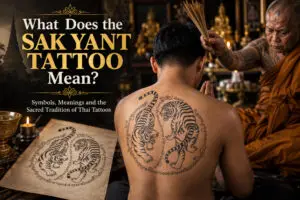
What does the Sak Yant Tattoo Mean?
What does the Traditional Thai Sak Yant Tattoo Mean?
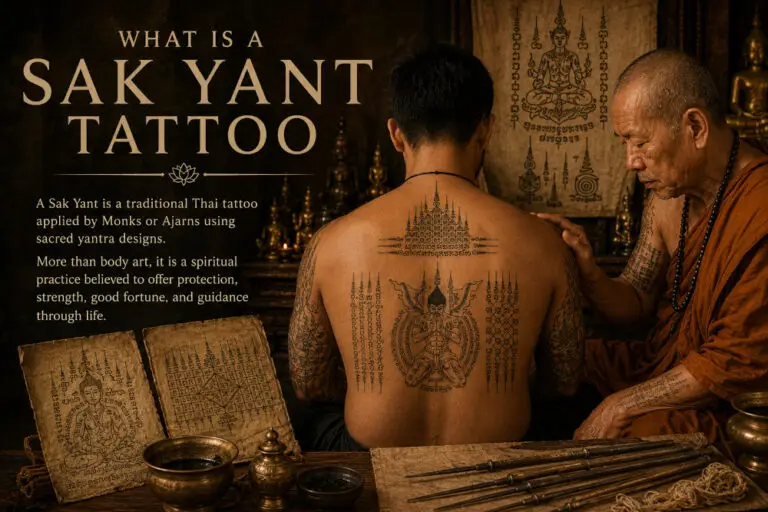
The Sak Yant Tattoo meaning is comprised of three factors
1) The Design
2) The Kata chanted by the Sak Yant Master during the Sak Yant Process
3) The Blessing given
It takes the Sak Yant Master many years to learn the magic of the traditional Thai tattoo, which (like any magical system) in large part derives it’s power from the expertise of the Master secret knowledge. Sak Yant Masters are very reluctant to impart this secret knowledge in any depth as the power of a genuine Sak Yant comes from the hidden knowledge of the Ajarn giving it. After all if anyone could read and understand what the Sak Yant tattoo means, then any old street tattoo artists could create them.
สักยันต์ – Sak Yant
Sak – meaning “to tap” or, “to tattoo”, and
Yant – meaning “Yantra”. Originally derived from the Sanskrit word “Yantra”
The 3 parts of the Sak Yant Tattoo Meaning
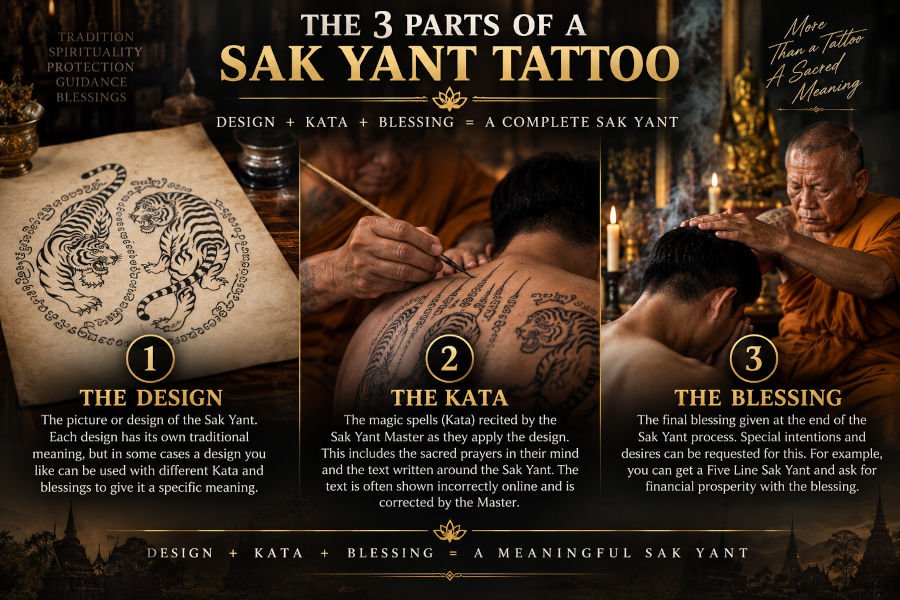
When getting the Sak Yant Tattoo, the meaning associated with the Tattoo comes in 3 parts; It is sometimes possible (It depends on the design itself) to have an imagine you want, but change the text and prayers and final blessing for a specific and special meaning. The 3 elements are …
1) The Design
This is the picture or design of the Sak Yant. While all Sak Yants come with their own meaning implicit to the design, if you like a certain design, it might be able to be used but changed to include the Kata and Blessing elements into the final meaning
2) The Kata
This includes the magic spells within the mind of the Sak Yant master as they create the Sak Yant. The master is reciting special prayers as they apply the design so that it becomes filled with the desired intention of the final design. The Kata also includes the text written around the Sak Yant. This text is usually presented incorrectly in drawn images you find online and are corrected by the Master. This is design to keep the knowledge so that only those qualified to give Sak Yants can give them.
3) The Blessing given
The final blessing given at the end of the Sak Yant Process. Special intentions and desires can be requested for this. For example you can get a Five Line Sak Yant and ask for financial prosperity with the blessing.
The Basics Meanings of the Sak Yant Design
The lines drawn in the Yant represent the Umbilical Cord of the Buddha, and are traditionally known as ‘The Bones of the Yant’. There are many varied forms of Yantra, it appears, such as; Round Yant, Triangular Yant, Four – Sided Yant, and even Pictorial ones.
Round Yant – represents the Face of the Buddha (Pra Pakt Khong Pra Putta Jao) in Brahmin Tradition, Brahma is applied as the meaning.
Triangular Yant – represents the Triple Gem of the Buddha Dharma and Sangha (Pra Put, Pra Tamm, Pra Songk). In Brahmin Tradition the three Lords of Heaven are applied as the meaning (Shiva Brahma, Vishnu)
Four sided Yant – represents the Four Elements / Continents (Earth, Water, Air and Fire)
Pictorial Yant (Animalistic) – represents various Angels, People, and Mythical Animals (Sathw Himapant)
Onk Pra represents The Buddha Himself.
The Half Moon Symbol to be seen above “Onk Pra” so often represents the Moon Illuminating the way for us in the Dark Hours.
The small Circle (Sun Symbol) to be seen above many Yant means the Sun lighting way in the daytime; and that all Humans and Living beings exist under the influences of the stars and Planets, and that these forces enable us to develop and brings Changes.
The Zig – Zag spiral line on the top of each Yant is called Unaalome. Unaalome represents the Saints who have attained the status of Enlightened beings. The Fetters of desire have been disentangled and discarded. These beings do not waver on their path as normal Humans do (Note the end of the zig zag evolves into a straight line, meaning that he has ceased to enter into diversion and is on a straight, direct path to Nirvana. The spiral in the middle represents the Crown of the Head of the Buddha. The Line of the Unaalome is straight and unwavering – Perfect and complete.
The Master Yant’s
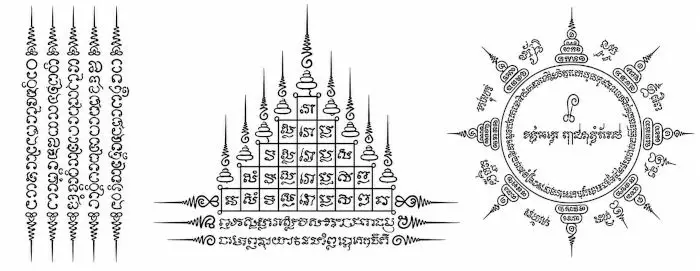 95% of the time your first, 2nd and even third Sak Yant will be one of the Master Yants. These designs cover everything, they are a little like your health, boat, car, flood and house insurance in one design. The three Master Yants are.
1) Hah Taew (5 Line)
2) Gao Yord (Buddha Peaks)
3) Paed Tidt (8 Direction)
“`html id=”q7m3kx”
95% of the time your first, 2nd and even third Sak Yant will be one of the Master Yants. These designs cover everything, they are a little like your health, boat, car, flood and house insurance in one design. The three Master Yants are.
1) Hah Taew (5 Line)
2) Gao Yord (Buddha Peaks)
3) Paed Tidt (8 Direction)
“`html id=”q7m3kx”
| Master Yant | Meaning and Purpose |
|---|---|
| Gao Yord, Nine Peaks | The Gao Yord is one of the most important and widely recognized Master Yants. It is traditionally associated with protection, strength, authority and spiritual protection from danger. The nine peaks represent sacred Buddhist and spiritual symbolism, and the Yant is often considered a foundational Sak Yant for people beginning their journey. |
| Hah Taew, Five Lines | The Hah Taew is one of the most recognizable Sak Yant designs, consisting of five sacred rows of Khom or Khata writing. Each line is traditionally associated with a different blessing, which can include protection, success, good fortune, attraction and avoidance of misfortune. The exact prayers and meanings can vary between Masters and lineages. |
| Paed Tidt, Eight Directions | The Paed Tidt represents protection in the eight directions and is traditionally associated with safety, protection while travelling and protection from danger wherever a person goes. Its circular arrangement represents the eight directions surrounding the recipient and is one reason it has become a popular choice for people who travel frequently. |
Meanings of the 3 Master Sake Yant Tattoos
1) The Hah Taew (5 Line) Design Sak Yant Tattoo Meaning
The Sak Yant Hah Taew dates its origin back over 700 years to the ancient Kingdom of Lanna which is now known as Northern Thailand. The Buddhist Monk credited with the design of the Hah Taew 5 Lines Sak Yant is Kruba Kam of Wat Ton Pin, a Buddhist Temple in Chiang Mai, which unfortunately no longer exists today. Kruba Kam designed the Hah Taew at around the time King Mengrai founded the city of Chiang Mai in 1296.
Over the centuries, either by accident or design, the original 5 lines of script which were written in Khom, an ancient Khmer language, underwent several changes and in recent years, several Sak Yant Ajarns have completely replaced the original 5 lines of script with lines of their own.
The 5 lines of script (transcribed) used in the original Hah Taew design are:
1. i ra cha ka ta ra sa
2. ti hang ja toh loh ti nang
3. soh ma na ga ri tah toh
4. pi sam lah loh pu sa pu
5. ka pu bam too tahm wa ka
Hah Taew, represents 5 yants or magical spells. Each one will be done individually and the following magical spells have been cast to do as described below.
1. The first row prevents unjust punishment and leans in your favor when the area is grey, cleans out unwanted spirits and protects the place you live in.
2. The second row reverses and protects against bad horoscope constellations and bad fortune.
3. The third row protects you from the use of black magic and anyone who tries to put a curse on you.
4. The fourth row energizes your good luck, success and fortune in your future ambitions and life style.
5. The fifth row is to gain charisma and attraction to the opposite sex. It is also is a boost to the fourth row.
2) The Gao Yord (9 Peaks) Design Sak Yant Tattoo Meaning
The Gao Yord is the “Yant Kru” or Master Yant and is a most sacred Buddhist tattoo with very wide ranging powers of protection and is quite possibly the most important of all the available Sak Yant designs. Many people will choose the Gao Yord as their first Sak Yant because of its universal powers and later add other Sak Yant designs of their choice.
The basic design of the Gao Yord represents the nine peaks of the mythical mountain of the Gods, Mount Meru. According to Hindu mythology, Mount Meru is the abode of the Lord Brahma as well as other Deities. In Buddhist mythology, Mount Meru is known as Sumeru.
The set of 3 ovals are a representation of the Lord Buddha and this grouping of 3 ovals can be seen in many other Sak Yant designs. The Gao Yord Yant has 9 Buddhas represented, with each Buddha bestowing special powers or spells. In some versions of the Gao Yord, there is a Mantra or Katha tattooed at the base of the design. The script used is Khom, an ancient Khmer script, and gives the abbreviation for the names of these nine Buddhas as follows;
A, Sang, Wi, Su, Loe, Pu, Sa, Pu, Pa
In the centre of the Gao Yord design is a patchwork of small squares, the magic box, (although in some designs the outlines are not shown but only the contents), each square containing an abbreviation (in Khom) for the names of all the protection spells that this Yant will bestow. The exact number of these small squares can vary according to the design but the powers granted to the wearer will always include the following.
Maeta Ma Hah Niyom: With this blessing you will be treated by others with great loving kindness and compassion which will improve your popularity and help you to gain preferential treatment.
Klaeoklad: This benefit ensures that the wearer will not suffer serious injury.
Chana Satru: The ability to defeat the enemy.
Ma Hah Amnat: This will give the wearer great power, authority and control over other people.
Awk Seuk: A willingness to go to war or to fight battles for those who have your loyalty and the desire to fight for what is right.
Kong Kra Phan: This will provide Magical protection and invincibility.
Oopatae: This will ensure that in whatever enterprise or business activities the wearer is involved in they will have the ability to do the work correctly and ensures that everything will run smoothly.
Ma Hah Saneh: This will give you charm and increase your popularity and attractiveness with the opposite sex.
Ma Hah Lap: This will bring great good fortune and luck.
Noon Chataa : This benefit will improve your destiny, fate
Pong Gan Antarai : This will give protection against accidents including natural disasters as well as giving protection against acts of violence.
Nah Tee Gan Ngan Dee : This benefit will help you to improve your circumstances at work
In addition The Sak Yant Gao Yord will protect the wearer against evil spirits and all forms of “Black Magic”.
3) The Paed Tidt (Eight Directions)
Design Sak Yant Tattoo Meaning
The Sak Yant design ‘Paed Tidt’ or Eight Direction Yant is a sacred Geometric Yant containing eight Mantras written in 2 concentric circles in the center of the design. The design of the Paed Tidt Yant also incorporates eight representations of the Buddha. These are the groups of 3 ovals each increasing in size from the top.
In Thailand, there is a Buddha image, each one in a different pose, for every day of the week. (On Wednesdays there are 2 Buddhas, one for the morning and one for the evening) and these 8 Buddha Images can be seen in many Thai temples, usually surrounding a Chedi.
The Paed Tidt Yant will give you protection in whichever direction you are traveling and ward off evil spirits. The script used on the Paed Tidt Yant is an ancient Khmer script known as Khom. The Mantras written in the Paed Tidt Yant and which should be chanted when going out to give further protection are as follows.
I RA CHA KA THA RA SAA (chant when traveling to the east – also chant and blow into your food for protection against illness/danger)
THI HANG JA THOE ROE THI NANG (chant when traveling Southeast)
BI SAM RA LOE BU SATH PUT (chant when traveling south )
SOE MAA NA GA RI TAA TOE (chant when traveling Southwest)
PA SAM SAM WI SA TAE PA (chant when traveling West)
KA PUT BAN TUU TAM WA KA (chant when traveling Northwest)
WAA TOE NOE A MA MA WAA (chant when traveling North)
A WICH SU NUCH SAA NU THI (chant when traveling Northeast)
Meanings of other Popular Designs and Design Sak Yant Tattoo Meanings
Hah Taew with Twin Birds, Sarika Koo
This variation combines the Five Lines with paired birds and is traditionally associated with charm, attraction, popularity and persuasive communication. It is often considered particularly suitable for people whose work depends on speaking, sales or personal relationships.
Hah Taew with Lotus, Dok Bua
This design combines the blessings of Hah Taew with the symbolism of the lotus. It is associated with love, good fortune, successful negotiations, kindness and spiritual cleansing.
Hah Taew Diamond, Chat Petch
The Five Diamond Yant combines the blessings of Hah Taew with additional diamond symbolism. It is traditionally associated with good fortune, success, charm, loving kindness and protection from negative influences.
Hah Taew with Moon
The addition of the moon to Hah Taew is associated with illumination, spiritual development and guidance. It is traditionally connected with improving one’s destiny and finding a clearer path through life.
Hah Taew with Ganesh
This combination brings together the Five Lines with Ganesh, a Hindu deity associated with wisdom, success and the removal of obstacles. It is therefore commonly associated with success, knowledge and overcoming difficulties.
Hah Taew with Ohm
This design combines Hah Taew with the sacred Ohm symbol. It is associated with protection, spiritual awareness, inner balance and a connection between the physical and spiritual aspects of life.
Hah Taew with Butterfly
The butterfly represents transformation, change and personal development. Combined with Hah Taew, the design is associated with protection, good fortune, attraction, spiritual growth and positive change.
Hah Taew with Naga
This variation combines the Five Lines with the Naga, a powerful spiritual serpent associated with protection, prosperity and good fortune. It is traditionally connected with wealth, safety, success and protection from danger.
Hah Taew with Twin Geckos
The gecko is traditionally associated with attraction, luck and abundance. When two geckos are combined with Hah Taew, the design is associated with protection, charm, romantic attraction, shared prosperity and success in achieving one’s intentions.
Paed Tidt, Eight Directions
Paed Tidt means Eight Directions and is traditionally associated with protection wherever a person travels. Its eight directional arrangement is connected with protection from danger and negative influences from all directions.
Paed Tidt Nahsuea
This variation of Paed Tidt emphasizes protection from the eight directions. It is traditionally associated with protection from danger, black magic and harmful influences.
Itipiso Paed Tidt
This design incorporates the Itipiso Buddhist chant into the Eight Directions concept. It is traditionally associated with strong protection, particularly against danger and harmful spiritual influences.
Na Paed Tidt
This variation incorporates sacred Na symbols into the Eight Directions design. It is generally associated with protection and the traditional protective qualities of Paed Tidt.
Paed Tidt Phromsinah
This variation adds a Na symbol associated with kindness to the Eight Directions design. It is traditionally connected with protection, safety and avoiding danger while also encouraging kindness and positive relationships.
Kroh Petch, Diamond Armour
Kroh Petch, meaning Diamond Armour, is traditionally represented as a protective shield. It is associated with protection from danger, negative energy, black magic and harmful spiritual influences.
Yant Soysungwarn, Sacred Necklace
The Soysungwarn Yant resembles a sacred necklace and is traditionally associated with invulnerability, strength and protection. Historically, it has been particularly associated with warriors and protection from physical danger.
Maha Aumnaj
Maha Aumnaj is associated with commanding power, authority and influence. It is traditionally considered suitable for people who hold positions of responsibility or leadership.
Na Lecha
Na Lecha is traditionally associated with protection, power and prestige, including protection against harmful spiritual influences.
Mong Kud
Mong Kud is associated with protection from bad luck and negative influences. It is traditionally regarded as a protective Yant.
Pok Kha Sap
Pok Kha Sap is traditionally associated with wealth, abundance and success in business. It is also connected with popularity, kindness and attracting favorable circumstances.
Yant Sumred
Yant Sumred is associated with success in different areas of life, including wealth, business, happiness and good fortune. It is also traditionally connected with popularity, kindness and confidence.
Yant Na Thong
Na Thong is associated with compassion, positive energy, peace and good fortune. It is traditionally considered beneficial for work, business and people seeking a more positive direction in life.
Medta Maha Niyom
Medta Maha Niyom is traditionally associated with charm, kindness and popularity. It is intended to encourage favorable relationships and positive reactions from other people.
Sarika Long Rung
Sarika Long Rung is associated with charm and attractiveness, particularly within personal relationships. It is traditionally connected with improving social and romantic appeal.
Yant Sarika Koo
Sarika Koo is traditionally associated with persuasive speech, charm, kindness and popularity. It is often considered suitable for people who rely on communication, sales or personal interaction in their work.
Yant Charueurn Panya
This Yant is associated with wisdom, intelligence and the ability to approach problems with greater understanding. It is traditionally chosen by people seeking knowledge and better judgment.
Yant Prachao Sibhok Phraong
This Yant is traditionally associated with strength, protection and invulnerability. It is connected with Buddhist protective qualities and is believed to provide protection against danger and harmful forces.
Kha Kuan Mueng
Kha Kuan Mueng is associated with peace, calmness and tranquility. It is traditionally chosen by people seeking greater balance and a more peaceful state of mind.
Kong Kra Pan
Kong Kra Pan is traditionally associated with physical protection, strength and safety from surrounding dangers. It is particularly associated with protective qualities.
Yant Takr
Yant Takr is traditionally associated with strength, protection and invulnerability. It is connected with the protective virtues of Buddhist sacred imagery.
Mongkut Phra Buddha Chao, Buddha Crown
This highly sacred Yant is traditionally associated with exceptional protection and invulnerability. It is connected with protection from physical danger, accidents, negative spiritual influences and untimely harm.
Baramee Samsib Tidt
Baramee Samsib Tidt is considered an all-purpose Yant associated with power, protection and attraction. It is also traditionally connected with love and favorable circumstances.
Maha La Luay
Maha La Luay is associated with kindness, love, good fortune and being well regarded by others. It is traditionally connected with attracting positive relationships and favorable circumstances.
Prachan PunJuk
This Yant is traditionally associated with a positive destiny and favorable direction in life. It is connected with good fortune and encouraging positive circumstances.
Itipiso Tri Juk
Itipiso Tri Juk is a pictorial representation of the powerful Itipiso Buddhist chant. It is traditionally associated with spiritual protection and the protective power of sacred Buddhist recitation.
Ka Te Si
Ka Te Si is traditionally associated with protection from danger, particularly protection against theft and harmful situations.
Yant Phraphrom, Brahma
Yant Phraphrom depicts Phra Phrom, the Thai representation of Brahma. It is traditionally associated with wisdom, prosperity, success, protection, balance and harmony.
Yant Ganesha, Phra Pikanet
Ganesha is traditionally associated with wisdom, success and the removal of obstacles. A Ganesha Yant is commonly connected with business success, prosperity, creativity and achieving one’s goals.
Suriya Prapa and Chanthara Prapa, Sun and Moon
The Sun and Moon Yant combines two powerful celestial symbols and is traditionally regarded as an all-purpose design. It is associated with bringing wishes toward fulfillment, balance and overcoming difficult circumstances.
Thao Vessavaana
Thao Vessavaana is a powerful guardian figure associated with protection, wealth and good fortune. In Buddhist tradition, he is regarded as a protector of the northern direction.
Hanuman
Hanuman is one of the most recognizable figures in Thai Sak Yant. Traditionally associated with courage, strength, protection and determination, Hanuman Yants are also connected with overcoming obstacles, confidence and the ability to influence others.
Hanuman Chern Tong
Hanuman Chern Tong depicts Hanuman carrying a victory flag. It is traditionally associated with victory over difficulties and enemies, courage and success, and has particular associations with soldiers and people in dangerous professions.
Hanuman Tua Ha
This Hanuman variation also incorporates the symbolism of a victory flag. It is traditionally associated with success, determination, achievement and overcoming obstacles in work and life.
Pahuman
Pahuman is another depiction of Hanuman and is traditionally associated with power, courage and the ability to overcome or control one’s enemies.
Vali
Vali, the Monkey King from the Ramakien, represents great strength and warrior ability. A Vali Yant is traditionally associated with power, courage and overcoming opposition.
Ongkod
Ongkod is a powerful monkey warrior from the Ramakien. The design is traditionally associated with strength, courage, leadership and the ability to overcome challenges.
Phra Ram, Rama
Phra Ram represents Rama, the central heroic figure of the Ramakien. The Yant is traditionally associated with justice, authority, courage, leadership, protection and overcoming enemies.
Yant Phrayakrut, Garuda
Garuda, known in Thailand as Phrayakrut, is traditionally associated with power, protection and authority. The design is connected with protection from danger, negative spiritual influences and harmful forces.
Yant Suea, Tiger
The tiger is traditionally associated with strength, power, courage, protection and authority. Tiger Yants are particularly popular among people in demanding or dangerous professions and among Muay Thai fighters.
Suea Koo, Twin Tigers
Twin Tigers are traditionally associated with exceptional strength, authority, courage and protection. The paired tigers are also connected with status, leadership and success in business.
Yant Suea Krajone, Leaping Tiger
The Leaping Tiger is associated with strength, power, courage and protection. It is traditionally considered a powerful design for people seeking confidence, authority and protection from danger.
Yant Suea Khlong
This tiger design is traditionally associated with power, protection and authority. It is connected with commanding respect and strength in positions of leadership.
Yant Suea Liaw Lung, Tiger Looking Back
The Tiger Looking Back is traditionally associated with protection from behind, authority, respect and strength. It is also connected with business, leadership and managing people.
Hong Ku, Golden Swan
The Golden Swan is associated with charm, popularity, kindness and self-sacrifice. Its symbolism comes from the Buddhist story of a compassionate and courageous golden swan.
Paya Hongtong
Paya Hongtong is traditionally associated with wealth, good fortune and genuine love. It combines the positive symbolism of the swan with prosperity and favorable relationships.
Phrayahong, Swan
This swan design is associated with kindness, charm, attractiveness, popularity and good fortune. It is traditionally connected with elegance and favorable relationships.
Paya Nok Hussadin
This mythical bird design is traditionally associated with power and the ability to overcome or control one’s enemies.
Kai Fah, Pheasant
Kai Fah is traditionally associated with beauty, love, wealth and good business. The pheasant’s symbolism is also connected with diligence, work and having a reliable source of income.
Konnok Mahalarp
Konnok Mahalarp is associated with good fortune, luck and success in love, education, work and business.
Charming Butterfly
The butterfly is traditionally associated with charm, popularity, transformation and positive change. This design is also connected with good fortune in relationships and business.
Yant Chang Sam Sien, Three-Headed Elephant
The three-headed elephant, associated with Erawan, is traditionally connected with strength, protection and authority. It is also considered beneficial for people who supervise others and for travelers seeking protection from harm.
Praya Chang, Elephant
The elephant represents strength, stability and protection and has deep cultural significance in Thailand and Southeast Asia. An elephant Yant is traditionally associated with strength and safety from danger.
Rat Cha See, King of Lions
The King of Lions Yant is traditionally associated with power, authority, leadership and earning the respect of others.
Racha Sri
Racha Sri, representing the lion, is traditionally associated with protection, strength and guarding against danger. Some variations are specifically connected with protection while sleeping.
Rachasri Pon
This lion design is associated with empowerment, confidence, strength and the ability to command respect.
Dragon
The dragon is traditionally associated with strength, power, protection and good fortune. Its fearsome character makes it particularly connected with authority and protection from physical danger.
Crocodile
The crocodile represents endurance, strength and physical protection. It is traditionally associated with protection from danger and is particularly popular among fighters and people working in risky professions.
Yant Tao Ruean, Turtle
The turtle is traditionally associated with longevity, wealth, success, good fortune and perseverance. Its symbolism also includes patience, independence and steady progress through life.
Phra Pidta
Phra Pidta depicts a Buddha figure with closed eyes and is traditionally associated with turning inward, spiritual development and protection. It is also connected with fortune and the ability to remain unaffected by external distractions.
Phra Pidta Taoruarn
This variation combines Phra Pidta with the symbolism of wealth and prosperity. It is traditionally associated with kindness, popularity, business success, abundance and good fortune.
Phraya Taoruarn
Phraya Taoruarn is traditionally associated with wealth, prosperity, good fortune and abundance. It is also connected with popularity, kindness and receiving favorable treatment from others.
Yant Nagaraj, Naga
The Naga is a powerful spiritual serpent traditionally associated with protection, prosperity, wealth and good fortune. In Northern Thai traditions, Nagaraj is also connected with sacred power and protection from danger.
Yant Plali, Eel
The eel is traditionally associated with smooth progress, good fortune, business success and the ability to move through difficult situations. It is also connected with kindness, charm and protection from opponents.
Phra Ta Nark
This serpent-based Yant is traditionally associated with protection, transformation, strength and invulnerability. The serpent symbolism is connected with adaptability, speed and elemental power.
Phaya Pla Lai Peuak
This design is traditionally associated with protection from physical threats and danger.
Lizard with Money Bag
The money bag lizard design is associated with attracting wealth, money and financial opportunity.
Nine Lizards
The Nine Lizards Yant is traditionally associated with luck in trade, finance and wealth. It is particularly connected with attracting favorable financial circumstances.
Yant Jingjok, Gecko
The gecko is traditionally regarded as a lucky creature and is associated with attraction, kindness, popularity and good fortune. The design is also connected with attracting customers, money and romantic relationships.
Yant Takarb, Centipede
The Centipede Yant is associated with balance, coordination, protection and resilience. Its many legs symbolize stability, while the design is traditionally connected with avoiding danger and maintaining strength under pressure.
Yant Singha Chearnthong
This lion design is traditionally associated with leadership, authority, victory and commanding respect. It is particularly suited to those in positions of responsibility or leadership.
Yant Moo Thong Deang, Wild Boar
The Wild Boar Yant is traditionally associated with strength, bravery, invulnerability and protection from harm and danger.
Yant Payamee, Bear
The Bear Yant is associated with strength, protection and perseverance. It is traditionally connected with overcoming obstacles and maintaining the determination to move forward.
Nine-Tailed Fox
The Nine-Tailed Fox is traditionally associated with attractiveness, charm and fortune, particularly in relationships and trading or business.
Yant Ling Lom
Ling Lom is connected with the monkey warriors of the Ramakien. The design is traditionally associated with power, authority, courage, protection and the ability to escape or avoid danger.
Pla Tapian Tong, Golden Fish
The Golden Fish is traditionally associated with wealth, prosperity and success in business and relationships. It can also symbolize a prosperous and harmonious partnership.
Kwang Liaw Lang, Deer
This design is traditionally associated with good fortune in work, finance and everyday circumstances.
Yant Rahu
Rahu, traditionally associated with eclipses and transformation, is used in Sak Yant symbolism for protection from bad luck and negative influences. It is also connected with resilience, transformation and overcoming difficult periods.
Yant Money Bag
The Money Bag Yant is traditionally associated with financial fortune, prosperity and successful business or trading activities.
Yant Mae Maai Ngeuak, Mermaid
The mermaid design is associated with charm, beauty, attraction and emotional power. It is traditionally connected with love, admiration, transformation and feminine spiritual symbolism.
Yant Thai Giant, Yak
The Thai Giant or Yak represents a powerful guardian figure. The design is traditionally associated with strength, protection, authority and guarding against danger.
Yant Buddha Nimit
Buddha Nimit is a highly sacred talismanic design incorporating the image of Buddha and sacred Buddhist writing. It is traditionally associated with spiritual protection and the sacred power of Buddhist symbolism.
Yant Phutson, Pra Jao Ha Pra Ong
Phutson is traditionally regarded as a powerful Maha Yant associated with love, charm, popularity, good fortune and success. It is also connected with career advancement and favorable circumstances.
Yant Phra Lakshmana
Phra Lakshmana is traditionally associated with charm, popularity, kindness, love and success in business. The design is connected with favorable relationships and advancement.
Yant Pirod Talisman
The Pirod is a traditional talismanic design. Its exact meaning can vary according to the Master and version, but it is generally associated with protective and auspicious qualities.