What is a Sak Yant Tattoo? – Thailands Traditional Tattoo
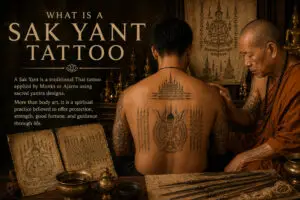
What Is a Sak Yant Tattoo?

A Sak Yant tattoo is a traditional form of sacred tattooing practiced in Thailand and other parts of mainland Southeast Asia. Unlike a conventional decorative tattoo, Sak Yant is traditionally connected to spiritual beliefs, sacred designs, inscriptions, the practitioner who applies it, and, depending on the tradition, rituals and blessings. The Thai word Sak Yant comes from Sak, meaning to tattoo or pierce, and Yant, derived from the Sanskrit Yantra, referring to a sacred or mystical diagram.

Sak Yant designs can include geometric patterns, animals, deities, Buddhist imagery and sacred inscriptions. Different designs are traditionally associated with qualities such as protection, strength, good fortune, confidence, attraction or other spiritual benefits. However, there is no single definition that describes every Sak Yant in Thailand. Different Monks, Ajarns, teachers and lineages can have their own designs, interpretations, ceremonies and practices.

Sak Yant Is More Than a Tattoo

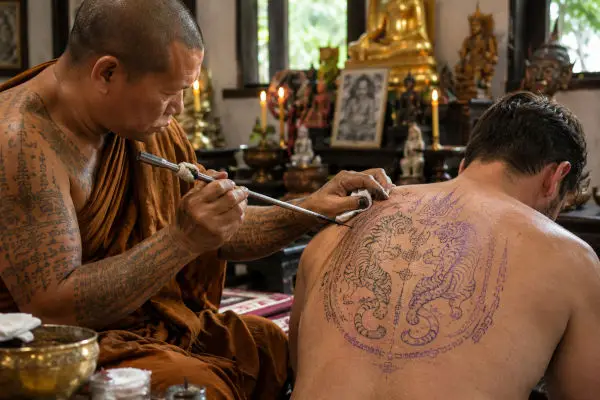
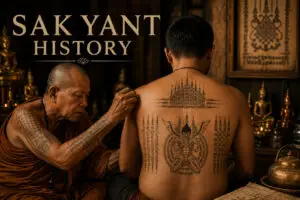
Monk making a Sak Yant TattooThe most important thing to understand about Sak Yant is that the tattoo itself is only one part of the tradition.A traditional Sak Yant can bring together several elements:

  • The design and its traditional symbolism
  • Sacred writing or inscriptions
  • The practitioner and their lineage
  • The intended purpose of the Yant
  • Traditional rituals or offerings
  • A blessing or other spiritual practice

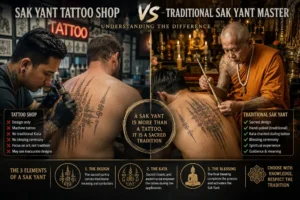
This is what separates traditional Sak Yant from simply copying a Sak Yant design onto the skin. A conventional tattoo artist can reproduce the appearance of a traditional Yant. That does not necessarily mean the tattoo has been received as a traditional Sak Yant.


Who Gives a Sak Yant? Monks and Ajarn Sak Yant Masters

Traditional Sak Yant is generally associated with Buddhist Monks and Ajarns, practitioners who have learned the tradition through teachers and established lineages.  An Ajarn is not simply another name for a tattoo artist. In the Sak Yant tradition, an Ajarn is a teacher or master, and many practitioners have spent years learning from an experienced teacher before becoming practitioners themselves.

Different Masters can come from very different backgrounds. Some follow family traditions, while others have learned through Monks, temples or established Sak Yant lineages. This is one reason it is important to consider who is performing a Sak Yant, rather than judging authenticity simply by its appearance or the tool used to apply it.

DifferenceSak Yant from a MonkSak Yant from an Ajarn
Religious statusAn ordained Buddhist Monk who has trained in the Sak Yant tradition.An Ajarn is generally a former Monk or spiritually trained Master who has left monastic life but continues to practice and teach traditional spiritual disciplines.
Where they usually workUsually lives and works at a Buddhist temple, where Sak Yant is performed as part of the temple environment.Usually works from a Samnak, a dedicated sacred room or private place for Sak Yant, rituals and blessings.
Rules and restrictionsFollows the stricter rules and protocols of Buddhist monastic life.Has fewer restrictions than an ordained Monk and can participate more freely in everyday life outside the temple.
Tattooing womenAt many temples, Monks do not tattoo women. This is related to traditional Buddhist rules concerning physical contact between Monks and women.Ajarns are generally able to tattoo both men and women.
Temple experienceThe experience is generally more formal and requires greater attention to temple etiquette, dress and behaviour.The experience is generally less formal and more relaxed, particularly when performed at a private Samnak.
PhotographyPhotography during the tattooing is generally not permitted when receiving a Sak Yant from a Monk at a temple.Photography and video are generally more flexible when receiving a Sak Yant from an Ajarn in a private setting.
Design choicesSome designs may be restricted because of the particular spiritual or magical significance attached to them.Ajarns generally have greater flexibility in the designs and purposes they can provide.
Spiritual practicesThe Sak Yant is performed within the Buddhist environment of the temple and may include Buddhist prayers, chanting and blessing.Ajarns may combine Buddhist blessings with other traditional Thai magical and spiritual practices learned through their lineage.
Personal requestsA Monk may limit certain designs or requests according to his religious duties and spiritual tradition.Ajarns generally have greater flexibility to provide Sak Yant according to a person’s individual intentions or desires.
Overall experienceMore formal, traditional and closely connected to the Buddhist temple environment.More flexible and private, while still allowing the traditional Sak Yant ritual and blessing to take place.

Traditional Sak Yant is generally associated with Buddhist Monks and Ajarns, practitioners who have learned the tradition through teachers and established lineages. An Ajarn is not simply another name for a tattoo artist. In the Sak Yant tradition, an Ajarn is a teacher or master, and many practitioners have spent years learning from an experienced teacher before becoming practitioners themselves.

Different Masters can come from very different backgrounds. Some follow family traditions, while others have learned through Monks, temples or established Sak Yant lineages. This is one reason it is important to consider who is performing a Sak Yant, rather than judging authenticity simply by its appearance or the tool used to apply it.

MONK
An Ordained Buddhist Monk
A Monk who performs Sak Yant is an ordained Buddhist Monk who has learned the traditional practice. The tattooing takes place within the Buddhist religious environment and is closely connected with the Monk’s spiritual training and lineage.

AJARN
A Sak Yant Master
An Ajarn is a teacher or Master who practices Sak Yant outside the Buddhist monastic order. Many Ajarns have learned Sak Yant and traditional spiritual practices through teachers, Monks and established lineages.

SETTING
Temple or Samnak
A Monk will normally perform Sak Yant at a temple or another space connected with the temple. An Ajarn will commonly work from a Samnak, a dedicated sacred space where Sak Yant, blessings and other traditional practices can take place.

MONASTIC RULES
Different Restrictions Apply
An ordained Monk must follow the rules of Buddhist monastic life. These rules can affect how and with whom a Monk is able to interact. An Ajarn is not bound by the same monastic restrictions and therefore has greater freedom in how they conduct their practice.

WOMEN
Important Difference for Female Visitors
At many temples, female visitors cannot receive a Sak Yant directly from a Monk because of traditional Buddhist rules concerning physical contact between Monks and women. Ajarns are generally able to tattoo both men and women.

TATTOOING METHOD
Both Can Use the Traditional Khem
Receiving a Sak Yant from a Monk does not mean a different tattooing technique is necessarily used. Both Monks and Ajarns may traditionally use a metal Khem, a long hand-poking needle used to apply the tattoo.

DESIGN & LINEAGE
The Lineage Matters More Than the Title
Different Monks and Ajarns can come from different teachers and lineages. This can affect the designs they use, the sacred writing, the meanings they give them and the rituals performed. The title Monk or Ajarn alone does not tell you the complete history of a Sak Yant tradition.

BLESSING
Both Can Perform Traditional Blessings
A Sak Yant from either a Monk or an Ajarn can involve prayers, sacred inscriptions, ritual and a blessing. The exact ceremony depends on the practitioner and the tradition or lineage they follow.

AUTHENTICITY
Monk or Ajarn Does Not Automatically Mean Authentic
A traditional Sak Yant is not defined simply by whether it was performed by a Monk or an Ajarn. The practitioner’s training, lineage, knowledge, traditional methods, sacred elements and ritual practice are all important when understanding the tradition.

What Makes a Real Sak Yant Tattoo vs. Tourist Bamboo Tattoo?

1) Sak Yant Designs and Their Meanings

Sak Yant contains hundreds of traditional designs, although some are considerably more widely recognised than others.  Among the best known are:

Gao Yord, the Nine Peaks, is traditionally associated with protection and spiritual power.

Hah Taew, the Five Lines, consists of five lines of sacred text traditionally associated with different blessings or qualities.

Paed Tidt, the Eight Directions, is traditionally associated with protection in all directions.

Suea, the tiger Yant, is commonly associated with strength, authority, courage and power.

The meaning of a Sak Yant can vary according to the Master, lineage, version of the design and associated inscriptions. A design found on one website may therefore be described differently somewhere else.  This is one of the reasons information about Sak Yant can be confusing for people researching online. For more information, see the best resource for Sak Yant Designs and Meanings available online

2) The Sacred Writing of Traditional Thai Sak Yant Tattoos

Many Sak Yant designs contain writing that may look unfamiliar to someone who has never encountered the tradition. This is not necessarily modern Thai writing. Traditional Sak Yant can incorporate Pali, Khom and Lanna scripts, together with sacred formulas, mantras and other forms of traditional writing. The writing can be an important part of the Yant’s purpose and meaning.

This is also why simply looking at a photograph of a Sak Yant may not tell you everything about it. Two designs can look similar while containing different inscriptions or being associated with different traditions. The subject of sacred writing deserves its own detailed discussion, particularly because translating these inscriptions into English is not always straightforward.

3) The Khem and Traditional Sak Yant Tattooing
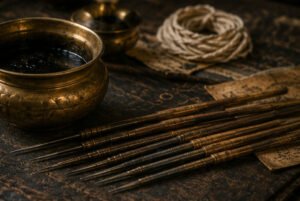
Traditional Sak Yant KhemsTraditional Sak Yant is commonly associated with a hand-poking instrument known as a Khem.

The Khem is traditionally a metal rod or needle used to repeatedly place ink into the skin. This differs from the electric tattoo machine commonly used in modern tattoo studios. The tool is one visible difference between traditional Sak Yant and conventional tattooing, but the tool alone does not make a tattoo a Sak Yant.

This is particularly important because the term “Bamboo Tattoo” has become closely associated with Sak Yant in the modern tourist industry. Despite the popular terminology, traditional Sak Yant is generally associated with the metal Khem rather than a bamboo stick.

A hand-poked tattoo and a traditional Sak Yant may therefore use similar techniques while representing very different practices.


4) The Role of the Rituals and Blessing – Charging the Sak Yant with Power

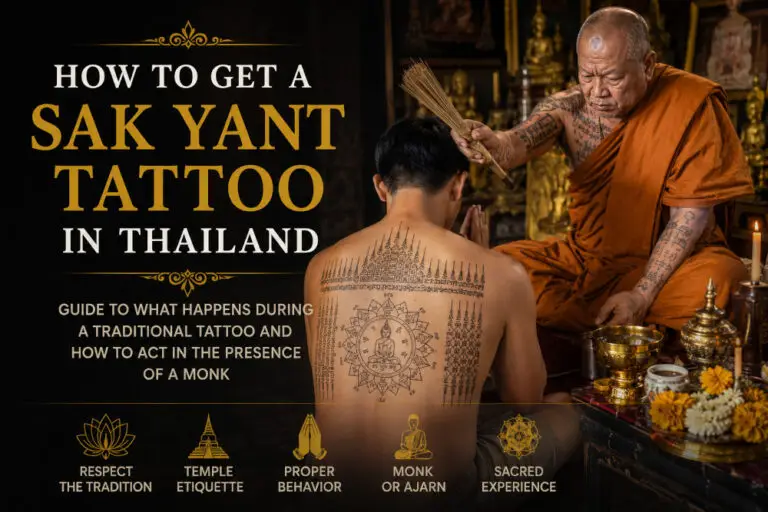
A Sak Yant is traditionally understood as more than an image placed permanently on the skin. The traditional process includes elements that give the tattoo its spiritual purpose, particularly the offering, the sacred text and the final blessing. An authentic Sak Yant involves an opening offering to the Master and tradition, personalized sacred or magical text connected to the intention of the person receiving it, and a blessing intended to charge the design. 

The Ritual Offering

Before the tattooing begins, an offering is made to the Master and the tradition. Flowers, incense, candles and other traditional offerings may be presented as a gesture of respect and gratitude. The offering is not simply payment for the tattoo. It represents respect for the knowledge, lineage and spiritual tradition being passed from the Master to the person receiving the Sak Yant.

The Blessing, Charging the Sak Yant

The blessing is considered an essential part of the traditional Sak Yant. After the design has been tattooed, the Master recites sacred Khata, or prayers, and performs a blessing over the Yant. Traditionally, this is understood as activating or charging the Sak Yant with its intended spiritual power, whether that purpose is protection, strength, success, prosperity or another quality associated with the design.

The exact prayers and ceremony can differ between Monks, Ajarns and different lineages. This is one reason a Sak Yant is not simply defined by the image on the skin. Within the traditional understanding, the design, sacred writing, ritual and blessing work together to give the Sak Yant its spiritual meaning and purpose.
Sak Yant and Buddhism

Sak Yant is strongly associated with Thai Buddhism, but describing it simply as a “Buddhist tattoo” can be misleading. The tradition has developed through the interaction of Buddhism with older regional beliefs and traditions, including Hindu-influenced concepts, yantra practices and local spiritual beliefs.

Some Sak Yant designs contain Buddhist imagery, while others feature animals, geometric patterns or sacred inscriptions. The result is a tradition with a complex cultural history rather than a single religious origin.

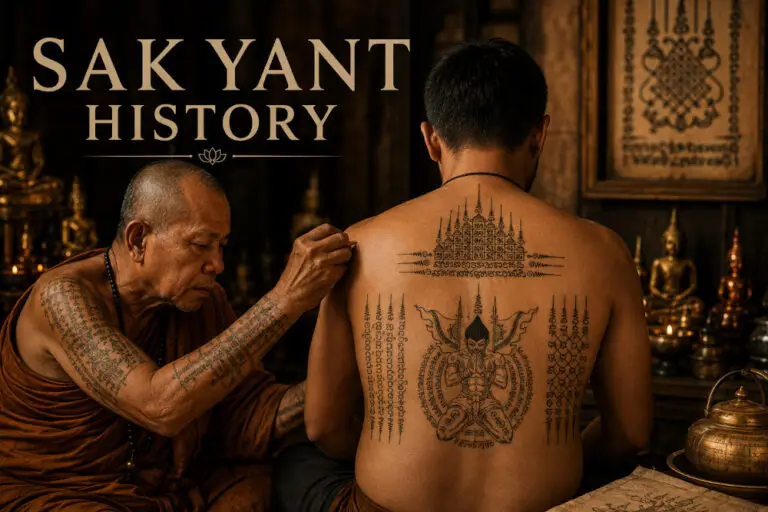
This history is explored in greater detail in The History of the Sak Yant Tattoo.

Why Are There Different Sak Yant Traditions?

One of the most important things to understand when researching Sak Yant is that there is no single authority controlling every practitioner in Thailand. Sak Yant has been passed from teacher to student through different lineages and regions for over 1000 years. Masters can therefore have different:

  • Teachers
  • Lineages
  • Designs
  • Sacred inscriptions
  • Interpretations
  • Ceremonies
  • Rules
  • Methods of choosing a Yant

This explains why two experienced practitioners may give different answers about the same design or practice. It also explains why information found online can sometimes conflict. A website describing a Yant may be presenting the interpretation of one Master, while another source may be describing a different version or lineage.

Rather than assuming that every difference represents misinformation, it is important to understand where the information comes from.  This is one of the main reasons Sak Yant Thailand was created.

Is Sak Yant Lineage important?

Lineage is often presented as one of the most important factors when choosing a Sak Yant Master, but it really is not a consideration outside of certain areas of Thailand.  The idea of lineage was developed to offer a guarantee of authenticity, quality or spiritual power. Sak Yant has been passed between Monks, Ajarns and teachers for generations, and recently with tattoo artist promoting ‘Bamboo Tattoos” citing Lineage became a way of making a distinction between real and fake Sak Yants

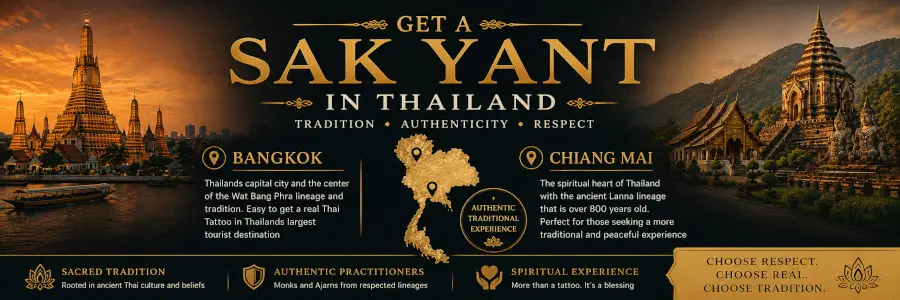
Promotion of Lineage is really only done by practitioners who received their training from Wat Bang Phra.  This Lineage is a mere few decades old and suffered most with the development of Tattoo Artists bamboo tattoos. In Northern Thailand the “Lanna” tradition and Lineage is documented with evidence to be over 800 years old, and locals giving recommendations to those seeking real Sak Yants – had generations of knowledge to make the distinctions.

For someone receiving a Sak Yant, the more important question is whether the Monk or Ajarn is genuinely trained, understands the tradition they practice, and treats the Sak Yant as a spiritual practice rather than simply a tattoo design. Lineage can help explain where a Master learned their knowledge, but the name or age of a lineage alone does not determine whether the experience is authentic.

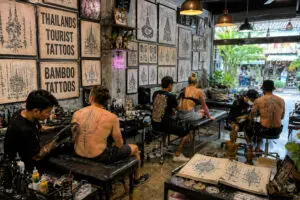
Avoiding Fake Sak Yants from Tattoo Shops

The international popularity of Sak Yant has created a large commercial market around traditional Thai tattoo imagery.

Today, tattoo studios may offer:

Sak Yant designs
Bamboo tattoos
Hand-poked tattoos
Traditional Thai tattoos
Sak Yant-inspired designs

These services can produce excellent tattoos, but the terminology can make it difficult for visitors to understand what they are actually receiving. A tattoo artist reproducing a traditional Yant design is not necessarily providing the same experience as receiving a Sak Yant from a practitioner who follows a traditional lineage. The distinction is not simply about whether the tattoo looks traditional or whether bamboo was used. It concerns the practice behind the tattoo.

For a detailed discussion, see Can a Tattoo Shop Give You a Traditional Sak Yant?

Choosing Your Sak Yant Design

Traditionally, many people relied heavily on their Monk or Ajarn to recommend a suitable design because they had little access to information about the different Yants. Today, the situation is different. There is extensive information available about Sak Yant designs, so it is perfectly reasonable to research the designs yourself and arrive with an idea of what interests you. The Ajarns and Monks prefer that you arrive with some knowledge.

Choosing a Sak Yant design is best approached by first considering why you want the tattoo and what qualities you hope it will represent. Traditional Sak Yant designs are associated with different purposes, including protection, good fortune, courage, confidence, attraction, authority, overcoming difficulties and personal development. Understanding your own intention gives you a better starting point than simply choosing an image because you like the way it looks.

Choosing the Sak Yant Design Is Only Part of the Process

It is important to understand that the visible image is only one part of a traditional Sak Yant. The design is accompanied by sacred text or Khata and a ritual and blessing performed by the practitioner. Depending on the design and lineage, the sacred text may be adapted to reflect the person’s particular intention. This means that two Sak Yants with a similar or even identical image can have differences in their sacred writing, purpose and blessing.

For a first Sak Yant, some of the traditional Master Yants, such as Gao Yord, Hah Taew and Paed Tidt, are popular because their meanings and blessings can cover a broad range of intentions. More specialised designs, including animals, mythical creatures and particular yantra forms, may be chosen when someone has a specific purpose in mind or already has a deeper understanding of Sak Yant traditions.

The Best Way to Choose the Sak Yant Design

A good approach is to research several designs, understand their traditional meanings and decide which qualities are important to you. You can then discuss your choice and your reasons for wanting the Sak Yant with the Monk or Ajarn. The practitioner can help determine whether the design is appropriate and what sacred text, blessing and ritual should accompany it.

You do not necessarily have to choose between your own preference and the Master’s knowledge. A traditional Sak Yant can be a collaborative process. You can have a strong preference for the image while allowing the practitioner to contribute the sacred elements that give the Yant its traditional spiritual meaning.

What Should You Know Before Getting a Sak Yant?

If you are considering receiving a Sak Yant, start by learning about the tradition rather than choosing a design based solely on appearance.

Consider:

  • Who will perform the Sak Yant?
  • What is their background and lineage?
  • What does the particular Yant mean in their tradition?
  • What sacred writing does it contain?
  • What happens during the ceremony?
  • Are there traditional rules associated with it?
  • What offerings or donations are appropriate?
  • What is expected of you during the experience?

There is no need to become an expert before receiving a Sak Yant. But understanding the basics allows you to make an informed choice and approach the experience with appropriate respect.  

Conclusion

A Sak Yant tattoo is more than a tattoo design or a method of putting ink into the skin. It is part of a living Thai tradition that can bring together sacred designs, inscriptions, spiritual beliefs, practitioners, lineages, rituals and blessings.

The exact practice varies between Monks, Ajarns and traditions. This variation is important and should not be hidden simply to provide a convenient one-size-fits-all explanation. It is also why the terms Sak Yant, Bamboo Tattoo, hand-poked tattoo and Thai tattoo should not automatically be treated as interchangeable.

A traditional Sak Yant is defined by the tradition and practice behind it, not simply by how the finished tattoo looks or which tool was used.

For anyone interested in receiving one, the best place to begin is with understanding.